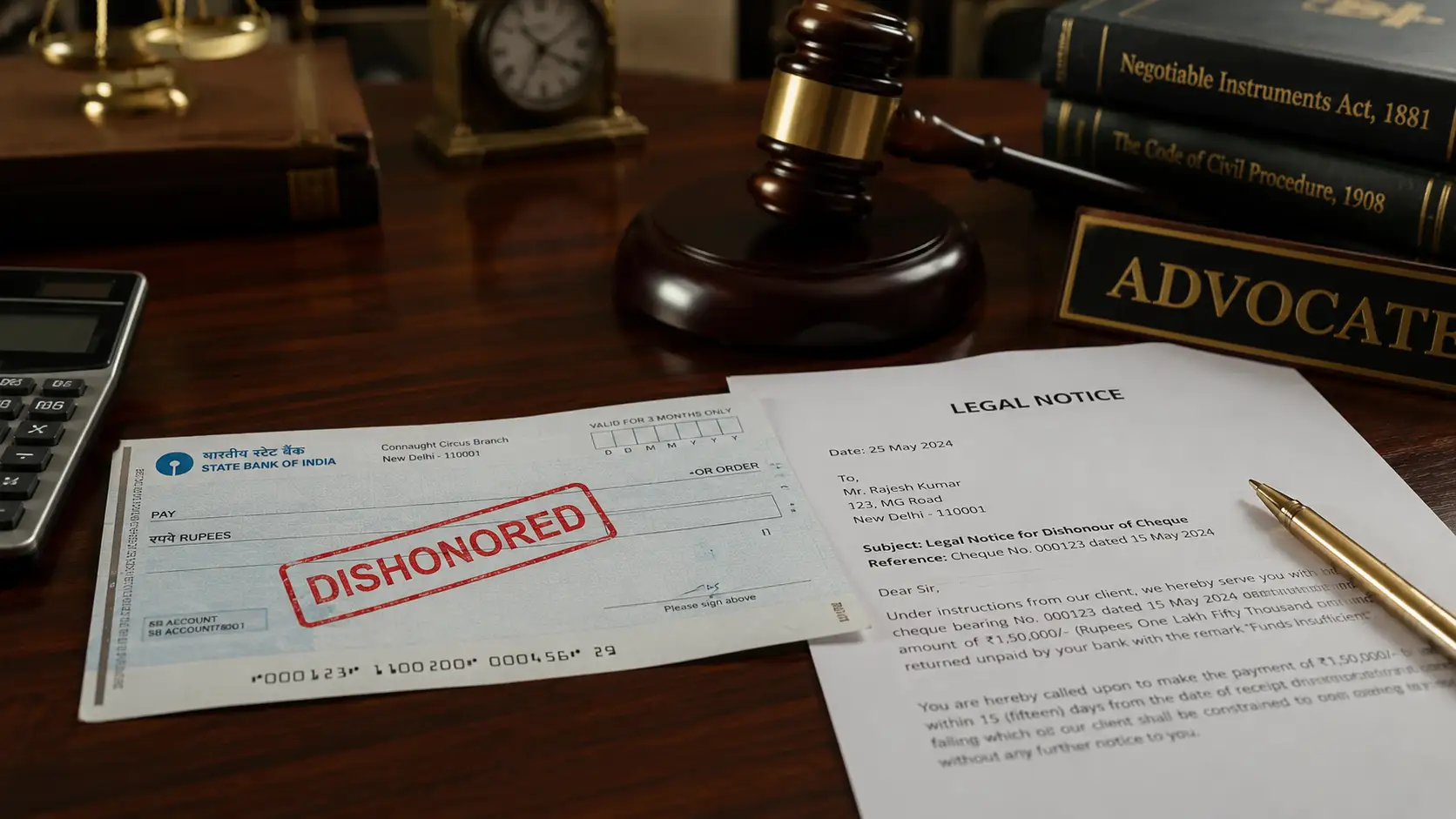
Receiving a bounced cheque in business or personal transactions is deeply frustrating. Whether you are a business owner collecting dues from a client, a landlord receiving rent, a lender getting a repayment, or a contractor awaiting payment for completed work—discovering that a cheque has dishonoured can bring operations to a complete standstill.
In India, a cheque usually bounces due to "Insufficient Funds", "Account Closed", "Signature Mismatch", or "Stop Payment Instructions".
While a cheque bounce might initially look like a simple banking glitch, Indian law treats the intentional issuance of a dishonoured cheque as a bailable criminal offense punishable by up to 2 years of imprisonment, a fine of up to double the cheque amount, or both.
Under Section 138 of the Negotiable Instruments Act, 1881 (NI Act), you have a solid, fast-track legal process to recover your unpaid funds. However, winning a cheque bounce case depends strictly on adhering to legal timelines. Missing a deadline by even a single day can extinguish your legal right to file a criminal complaint.
In this practical legal guide, we break down statutory timelines, explain key amendments (such as the mandatory 20% Interim Compensation under Section 143A), provide two free ready-to-use legal notice and complaint petition formats, and outline the complete court recovery procedure.
Strict Statutory Timelines Under Section 138 NI Act
To successfully prosecute a cheque bounce case, you must strictly follow this legal timeline established by Indian courts:
[Cheque Bounce Happens] │ ▼ (Within 30 Days of Cheque Return Memo) [Send Statutory Legal Demand Notice] │ ▼ (Wait 15 Days for Drawer to Pay) [15-Day Mandatory Payment Window] │ ▼ (If Unpaid within 15 Days) [File Criminal Complaint in Magistrate Court within 30 Days]
| Legal Step | Statutory Time Limit | Action Required |
|---|---|---|
| Cheque Validity | Within 3 Months from Cheque Date | Present cheque to bank before it expires. |
| Cheque Return Memo | Instant (Issued by Bank) | Collect original bounced cheque and Cheque Return Memo from bank. |
| Sending Legal Notice | Within 30 Days of receiving Return Memo | Dispatch formal legal demand notice via Speed Post/Registered Post. |
| Mandatory Waiting Period | 15 Days from Notice Receipt | Give drawer 15 calendar days to pay the dishonoured amount. |
| Filing Court Complaint | Within 30 Days after expiry of 15 days | File criminal complaint u/s 138 NI Act in Metropolitan/Judicial Magistrate Court. |
Essential Pre-Requisites for Filing a Section 138 Case
Not all bounced cheques qualify for criminal prosecution under Section 138. Ensure your case satisfies these four legal prerequisites:
- Legally Enforceable Debt: The cheque must have been issued to discharge a legally enforceable debt or liability (e.g., business invoice, loan repayment, rent). Cheques given as advance security or gifts generally do not qualify unless backed by an agreement.
- Valid Presentation: The cheque must have been presented to the bank within its validity period (3 months from the date written on the cheque).
- Official Return Memo: You must possess the official Cheque Return Memo issued by the bank clearly stating the reason for dishonour (e.g., "Funds Insufficient" or "Exceeds Arrangement").
- Demand Notice Issued: A formal written demand notice must be served on the drawer within 30 days of receiving the return memo.
Template 1: Statutory Legal Demand Notice under Section 138 NI Act
Send this formal legal notice via Speed Post with Proof of Delivery (POD) or Registered Post AD. You can issue this notice yourself or through an advocate.
LEGAL DEMAND NOTICE (Issued under Section 138 of the Negotiable Instruments Act, 1881)
REGISTERED POST A.D. / SPEED POST
Date: [Insert Date]
TO (DRAWER / ISSUER OF CHEQUE): To, [Name of Opposing Party / Business] S/o, D/o: [Father's Name, if known] Address: [Complete Residential or Office Address] Mobile No: [+91-XXXXXXXXXX] Email: [Email Address]
FROM (PAYEE / HOLDER IN DUE COURSE): [Your Full Legal Name] Address: [Your Complete Address] Mobile No: [+91-XXXXXXXXXX]
SUBJECT: Demand Notice under Section 138 of Negotiable Instruments Act, 1881 for dishonour of Cheque No. [Cheque Number] dated [Cheque Date] drawn on [Bank Name] for Rs. [Amount].
Sir/Madam,
Under instructions from my client / As the Payee of the subject cheque, I hereby serve you with this statutory Legal Demand Notice:
That you are known to me/my client and in discharge of your pre-existing legally enforceable debt/liability towards [explain cause, e.g., purchase of goods vide Invoice No. XYZ / repayment of friendly loan taken on Date], you issued a cheque in my/my client's favor.
The particulars of the said cheque are as follows:
- Cheque Number: [6-digit Cheque No, e.g., 000123]
- Cheque Date: [DD/MM/YYYY]
- Amount: Rs. [Amount in Figures]/- (Rupees [Amount in Words] Only)
- Drawee Bank: [Name of Issuer's Bank & Branch]
That relying on your assurance that the cheque would be honored upon presentation, I/my client presented the aforementioned cheque for encashment through my/my client's bank, [Name of Your Bank & Branch].
That to my/my client's utter shock and dismay, the said cheque was returned unpaid/dishonoured by your bank vide Cheque Return Memo dated [Date of Return Memo] with the official endorsement: "[Insert Reason, e.g., Funds Insufficient / Account Closed / Stop Payment]". The said return memo was received by me/my client on [Date of Receipt].
That you issued the said cheque fully knowing that there were insufficient funds in your account, thereby committing an act of cheating and dishonour under Section 138 of the Negotiable Instruments Act, 1881.
I hereby call upon you through this notice to pay the full cheque amount of Rs. [Amount in Figures]/- (Rupees [Amount in Words] Only) to me/my client within 15 (Fifteen) Days from the date of receipt of this notice.
Please note that if you fail to make the full payment of the cheque amount within the statutory period of 15 days, I shall be constrained to initiate criminal proceedings against you under Section 138 and Section 142 of the Negotiable Instruments Act, 1881, as well as under relevant provisions of the Bharatiya Nyaya Sanhita (BNS) in the competent Magistrate Court at [Your Location], holding you fully responsible for all legal expenses, court costs, and statutory damages.
Yours faithfully,
(Signature) [Your Full Legal Name / Advocate Name] [Contact Phone Number] [Full Address]
Template 2: Criminal Complaint Petition Draft (Magistrate Court Format)
If the drawer fails to pay within 15 days of receiving your legal notice, draft and submit your criminal complaint petition in court within the next 30 days.
IN THE COURT OF THE HON'BLE CHIEF METROPOLITAN MAGISTRATE / JUDICIAL MAGISTRATE FIRST CLASS AT [YOUR CITY/DISTRICT]
CRIMINAL COMPLAINT NO. _____ OF 2026
IN THE MATTER OF:
[YOUR FULL NAME] S/o, D/o: [Father's Name] Resident of: [Your Complete Address] ... COMPLAINANT / PAYEE
VERSUS
[ACCUSED FULL NAME / COMPANY NAME] Through its Director / Proprietor Address: [Complete Address of Accused] ... ACCUSED / DRAWER
COMPLAINT UNDER SECTION 138 READ WITH SECTION 142 OF THE NEGOTIABLE INSTRUMENTS ACT, 1881 FOR DISHONOUR OF CHEQUE
MOST RESPECTFULLY SHOWETH:
1. JURISDICTION: That this Hon'ble Court has territorial jurisdiction to try and entertain the present complaint under Section 142(1)(b) of the Negotiable Instruments Act as the Complainant maintains their bank account with [Name of Your Bank Branch Address], where the cheque was delivered for collection.
2. FACTS OF THE CASE: a) That the Accused approached the Complainant for [explain transaction/debt cause] and in discharge of the said legal liability, the Accused issued Cheque No. [Cheque No] dated [Date] for an amount of Rs. [Amount]/- drawn on [Accused Bank Name]. b) That the Complainant presented the said cheque through their banker [Complainant Bank Name] on [Presentation Date]. c) That the cheque was returned dishonoured vide Bank Return Memo dated [Memo Date] with remarks "Funds Insufficient" (Annexure C-2). d) That the Complainant issued a statutory Legal Demand Notice dated [Notice Date] via Speed Post (Tracking ID: [Insert ID]) which was served on the Accused on [Delivery Date] (Annexure C-3 & C-4). e) That despite receipt of the notice, the Accused failed to make payment within the mandatory 15-day period, which expired on [Expiry Date]. Hence, the Accused has committed a criminal offence u/s 138 NI Act.
3. PRAYER / RELIEF SOUGHT: It is therefore most respectfully prayed that this Hon'ble Court may be pleased to: a) Summon, try, and punish the Accused under Section 138 of the Negotiable Instruments Act, 1881. b) Direct the Accused to pay twice the cheque amount (Rs. [2x Amount]/-) as compensation to the Complainant as permitted under Section 357 CrPC / 395 BNSS. c) Direct the Accused to pay 20% of the cheque amount as Interim Compensation under Section 143A of the NI Act during trial proceedings.
PLACE: [Your City] DATE: [Insert Date]
COMPLAINANT (Signature)
Key Legal Provisions: Section 143A & Section 148 Amendments
Recent statutory amendments have strengthened the position of cheque payees during prolonged court trials:
- Section 143A (Interim Compensation during Trial): The Magistrate Court can order the drawer/accused to pay up to 20% of the cheque amount as Interim Compensation to the complainant during the trial stage itself. The accused must deposit this within 60 days of the court order.
- Section 148 (Deposit in Appeal): If the accused is convicted and files an appeal in the Sessions Court, the appellate court mandates the deposit of a minimum 20% of the fine/compensation awarded by the trial court before granting bail or stay on conviction.
Court Fees & Territorial Jurisdiction Rules
Where do you file a cheque bounce case, and how much court fee must you pay?
1. Territorial Jurisdiction Rule (2015 Amendment)
You must file the complaint in the court having jurisdiction over the bank branch where YOU (the Payee) maintain your account and presented the cheque for collection. You no longer need to travel to the city where the drawer resides or where their bank branch is located.
2. Court Fee Calculation
Court fees for Section 138 complaints vary by Indian state, generally ranging from 1% to 5% of the cheque amount (capped at maximum limits in certain states).
| Cheque Amount Range | Approximate Court Fee |
|---|---|
| Up to Rs. 50,000 | Rs. 200 – Rs. 500 |
| Rs. 50,000 to Rs. 2,000,000 | 1% to 2% of Cheque Amount |
| Above Rs. 2,000,000 | Scaled court fee schedule per State Court Fees Act |
Essential Evidence Checklist for Cheque Bounce Cases
To secure a conviction and fast recovery, attach these key documents to your court complaint petition:
[Original Bounced Cheque] ➔ [Original Return Memo] ➔ [Copy of Legal Notice] ➔ [Speed Post Receipt & Delivery Proof] ➔ [Debt Proof (Invoices/Agreements)]
- Original Dishonoured Cheque: The original physical paper cheque.
- Original Cheque Return Memo: Official bank paper stamped by your bank.
- Office Copy of Legal Notice: Signed copy of the legal demand notice sent.
- Postal Speed Post Receipt & POD: Physical post office receipt and printout of the online India Post tracking delivery confirmation report showing "Item Delivered".
- Debt Evidence: Tax invoices, contract agreements, ledger accounts, or bank statements proving the existence of the underlying debt.
4 Mistakes That Can Destroy Your Cheque Bounce Case
- Missing the 30-Day Notice Window: If you fail to send the legal notice within 30 days from the date you received the return memo, your case under Section 138 will be dismissed for lack of statutory compliance.
- Accepting a Fresh Cheque Without Strategy: If the drawer asks you to re-present the cheque or gives a replacement cheque, ensure the fresh cheque is presented within its validity period.
- Failing to Retain Speed Post Delivery Proof: Courts require concrete proof that the notice reached the drawer's address. Always save and print the official India Post delivery tracking status report.
- Not Naming Directors in Company Cases: If the cheque was issued by a Pvt Ltd or Partnership firm, you must name both the Company/Firm AND the Active Directors / Partners responsible for daily operations under Section 141 of the NI Act.
Conclusion
A bounced cheque does not mean your money is lost. By leveraging the strict provisions of Section 138 of the Negotiable Instruments Act, adhering to statutory notice timelines, and utilizing the legal notice and complaint templates provided above, you can enforce financial accountability and recover your unpaid dues through court-mandated compensation.
*Disclaimer: This blog post and downloadable legal formats are provided strictly for educa