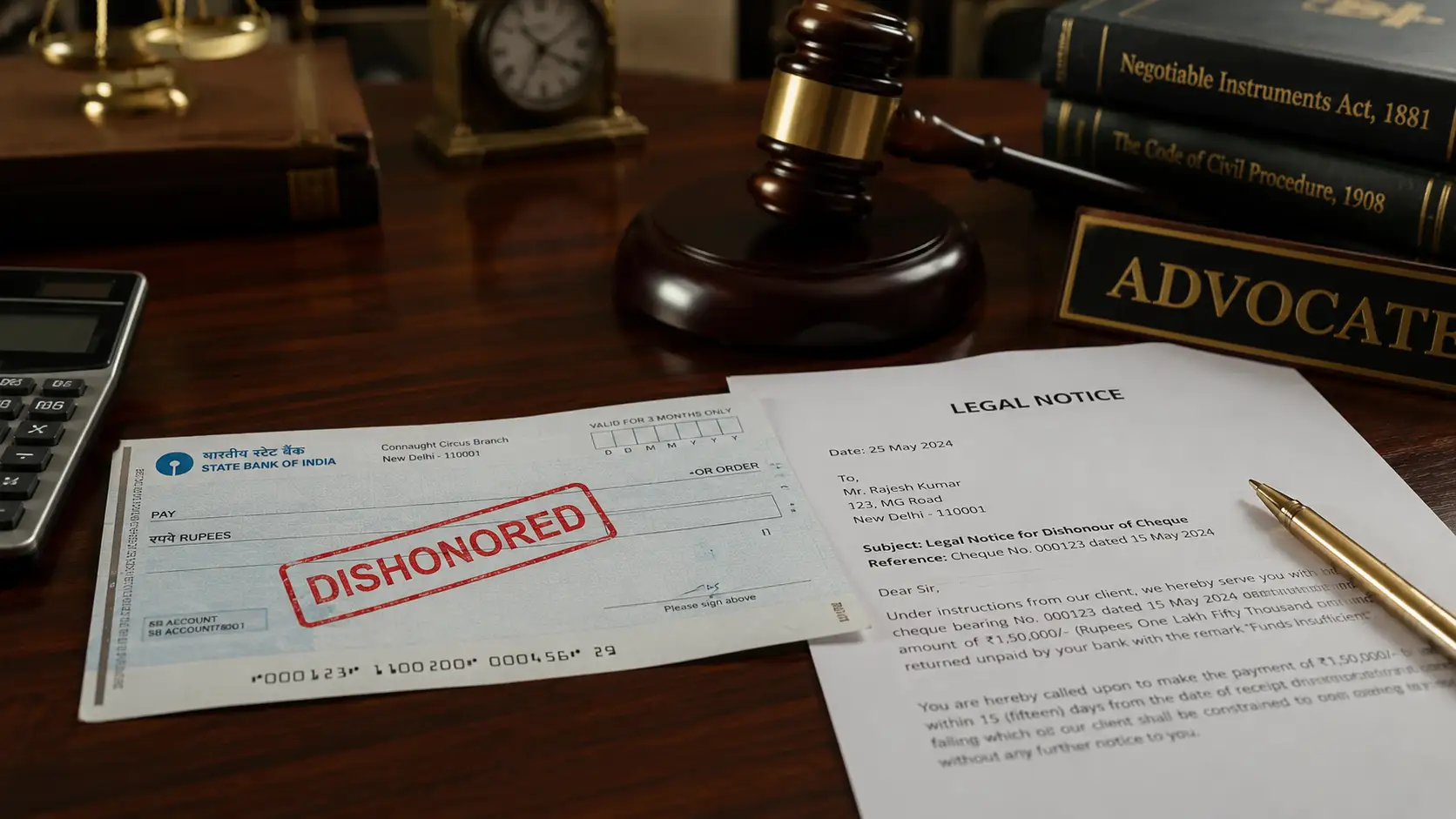
Receiving a bounced cheque in business or personal financial transactions is one of the most frustrating experiences in India. Whether you lent money to a friend, sold goods to a client, or received payment for services rendered, a dishonored cheque immediately halts your cash flow and breaches trust.
In India, a cheque bounce is not merely a civil breach of contract; under Section 138 of the Negotiable Instruments Act, 1881 (NI Act), it is a cognizable criminal offense punishable by up to two years of imprisonment, a monetary fine up to twice the cheque amount, or both.
However, before you can initiate criminal proceedings in court against the defaulter, Indian law mandates a critical first step: sending a statutory Legal Notice within 30 days of cheque dishonor.
In this detailed guide, we explain the mandatory legal timelines under Section 138, highlight the essential ingredients of a legally binding notice, detail the court recovery process, and provide a free, ready-to-use Cheque Bounce Legal Notice Format in English.
Understanding Section 138 of the Negotiable Instruments Act, 1881
Section 138 was inserted into the Negotiable Instruments Act to instill credibility in bank transactions and cheque payments. To invoke criminal liability under Section 138, specific statutory conditions must be satisfied:
- Legally Enforceable Debt: The cheque must have been issued by the drawer to discharge a legally valid debt or liability (e.g., loan repayment, invoice payment, rent). Cheques issued as advance payments or gifts do not always attract Section 138 unless liability is established.
- Cheque Validity Period: The cheque must be presented to the bank within its validity period (usually 3 months from the date written on the cheque).
- Dishonor by Bank: The cheque must be returned unpaid by the bank due to "Insufficient Funds," "Account Closed," "Exceeds Arrangement," or "Stop Payment" orders.
- Mandatory Demand Notice: The payee (holder) must issue a written legal notice to the drawer demanding payment within 30 days of receiving the Cheque Return Memo from the bank.
- 15-Day Cure Period: The drawer is given 15 calendar days from the receipt of the legal notice to pay the cheque amount.
- Cause of Action: If the drawer fails to make the payment within these 15 days, a criminal cause of action arises, allowing you to file a complaint in the Magistrate Court within the next 30 days.
Critical Timelines in Cheque Bounce Cases (Statutory Deadlines)
Missing a legal deadline in a cheque bounce case can permanently destroy your legal right to file a criminal complaint under Section 138. Memorize this timeline carefully:
| Legal Event | Statutory Time Limit | Action Required |
|---|---|---|
| Cheque Presentation | Within 3 months of cheque date. | Deposit cheque in your bank account. |
| Cheque Return Memo | Issued by bank within 1-3 days. | Obtain the official original Return Memo stating reasons for bounce. |
| Legal Notice Issuance | Strictly within 30 days of receiving Return Memo. | Draft and dispatch Legal Notice via Registered Post / Speed Post. |
| Notice Grace Period | 15 Days from receipt of notice by drawer. | Wait for drawer to clear payment. |
| Filing Court Complaint | Within 30 days after the 15-day notice period expires. | File criminal complaint under Sec 138 in Metropolitan Magistrate Court. |
Common Reasons for Cheque Dishonor
When a cheque bounces, your bank issues an official document called the Cheque Return Memo containing a specific reason code. Common reasons that qualify under Section 138 include:
- Funds Insufficient (Reason Code 01): The account lacks adequate balance to cover the cheque amount.
- Exceeds Arrangement (Reason Code 02): The cheque amount exceeds the pre-agreed overdraft limit.
- Signature Differs / Mismatches (Reason Code 03/04): Signature on cheque does not match bank records (often deliberately done to stall payment).
- Account Closed (Reason Code 05): The drawer closed the bank account prior to presentation.
- Payment Stopped by Drawer (Reason Code 06): The drawer instructed the bank not to clear the cheque.
8 Essential Elements Every Cheque Bounce Notice Must Contain
A poorly drafted legal notice can be easily challenged in court by the defaulter's lawyer. Ensure your notice contains these 8 non-negotiable points:
- Party Details: Full legal name, address, and contact details of both Payee (Complainant) and Drawer (Accused).
- Transaction Details: Complete narrative explaining how the legal debt/liability arose (e.g., invoice numbers, loan agreements, goods delivered).
- Cheque Information: Exact cheque number, cheque date, drawer's bank name, and branch.
- Presentation & Dishonor Details: Date of depositing cheque and date of receiving the bank's Cheque Return Memo.
- Specific Demand Amount: Explicit demand for the exact cheque sum (do not add interest or legal fees directly into the core demand amount, though you can mention them separately).
- Statutory 15-Day Demand: Unconditional demand asking the drawer to clear the dues within 15 days from the date of receiving the notice.
- Criminal Warning: Explicit mention that failure to pay within 15 days will result in criminal prosecution under Section 138 of the NI Act and Section 420 (Cheating) of the Indian Penal Code / Bharatiya Nyaya Sanhita (BNS).
- Mode of Dispatch Details: Sent via Registered Post with Acknowledgment Due (AD) or Speed Post to ensure legal proof of delivery.
Free Cheque Bounce Legal Notice Format (English Draft)
You can copy the legal notice format below, substitute your specific details inside the brackets [ ... ], and send it via Speed Post or through an Advocate.
LEGAL NOTICE UNDER SECTION 138 OF THE NEGOTIABLE INSTRUMENTS ACT, 1881
REGISTERED POST WITH ACKNOWLEDGMENT DUE / SPEED POST
Date: [Insert Date of Notice, e.g., July 20, 2026]
TO, [Name of the Defaulter / Drawer] Son/Daughter/Wife of: [Father's/Husband's Name] Resident Address: [Complete Address of Defaulter with PIN Code] Designation/Company Name (if applicable): [Company Name & Registered Address] Mobile Number: [+91-XXXXXXXXXX] | Email ID: [Email Address]
FROM, [Your Name / Advocate's Name] Address: [Your Complete Postal Address with PIN Code] Mobile Number: [+91-XXXXXXXXXX] | Email ID: [Email Address]
SUBJECT: Legal Notice under Section 138 of the Negotiable Instruments Act, 1881 for dishonor of Cheque No. [Cheque Number] dated [Cheque Date] for Rs. [Amount in Figures]/-.
Sir / Madam,
Under instructions from and on behalf of my client, [Your Name], residing at [Your Full Address] (hereinafter referred to as "my Client"), I hereby serve upon you this Statutory Legal Notice as follows:
That my Client is engaged in [mention business or relationship, e.g., business of wholesale garments / a known acquaintance of yours].
That towards the discharge of your pre-existing legal debt and financial liability for [explain reason, e.g., goods supplied against Invoice No. XYZ / repayment of personal friendly loan taken on Date], you issued a cheque in favor of my Client with the following details:
- Cheque Number: [Insert Cheque Number]
- Cheque Date: [Insert Cheque Date]
- Amount: Rs. [Insert Amount in Figures]/- (Rupees [Insert Amount in Words] Only)
- Drawee Bank: [Insert Defaulter's Bank Name & Branch]
That my Client presented the aforementioned Cheque for encashment through their bank, [Your Bank Name, Branch Name], within its statutory validity period.
That to the utter shock and dismay of my Client, the said Cheque was returned unpaid/dishonored by your bank vide Cheque Return Memo dated [Insert Date on Return Memo] with the official remark: "[Insert Reason, e.g., Funds Insufficient / Account Closed / Stop Payment]". My Client received the said Cheque Return Memo from their bank on [Insert Date You Received Memo].
That you issued the said Cheque fully aware that there were insufficient funds in your bank account, thereby dishonestly inducing my Client to accept the Cheque with deliberate intention to deceive and cheat.
That by your acts of issuing a dishonored cheque and failing to arrange sufficient funds, you have committed a criminal offense punishable under Section 138 of the Negotiable Instruments Act, 1881.
THEREFORE, through this Legal Notice, I hereby call upon you to make payment of the total sum of Rs. [Insert Cheque Amount]/- (Rupees [Insert Amount in Words] Only) to my Client within 15 (Fifteen) days from the date of receipt of this notice.
Please take notice that if you fail to pay the aforesaid amount within the stipulated statutory period of 15 days, my Client shall be constrained to initiate criminal proceedings against you in the competent Magistrate Court under Section 138 of the Negotiable Instruments Act, 1881, at your sole cost and risk.
You shall also be liable to pay my Client a sum of Rs. [e.g., 5,000]/- towards the legal charges incurred for drafting and sending this notice.
Copy of this Legal Notice is retained in my office for record and further legal proceedings.
[Your Signature / Advocate's Signature]
[Your Name / Advocate's Name]
Step-by-Step Procedure to Send the Legal Notice
- Print on Plain Paper or Letterhead: If you are sending it yourself, print it on clean A4 paper. If sending through a lawyer, it will be printed on the lawyer's letterhead.
- Sign Every Page: Sign at the bottom of each page of the notice.
- Dispatch via India Post Speed Post: Go to the nearest Post Office and send the notice strictly via Speed Post or Registered Post with Acknowledgment Due (AD). Do not use private couriers, as Indian courts heavily favor India Post tracking receipts.
- Preserve Postal Receipts & Tracking Report: Keep the postal receipt safely. Download and print the delivery tracking report from the official India Post website showing the status as "Item Delivered." The 15-day countdown begins from the date of delivery.
What to Do If the Defaulter Does Not Pay in 15 Days?
If the 15-day demand period expires and the defaulter fails to pay, you must take the following steps immediately:
1. File a Criminal Complaint under Section 138
Engage an advocate to draft a formal criminal complaint. File the complaint in the Metropolitan Magistrate Court or Judicial Magistrate First Class (JMFC) court having jurisdiction over the area where your bank branch is located (where you deposited the cheque).
2. Jurisdiction Rule (Dashrath Rupsingh Rathod Case Amendment)
As per the Negotiable Instruments (Amendment) Act, 2015, the jurisdiction for filing a Section 138 case lies with the court within whose local jurisdiction the payee's bank branch (where the cheque was delivered for collection) is situated.
3. Documents Required in Court
- Original Bounced Cheque.
- Original Cheque Return Memo.
- Copy of Legal Notice with Postal Tracking Receipt & Delivery Proof.
- Evidence Affidavit detailing the transaction.
4 Mistakes That Can Ruin Your Cheque Bounce Case
- Missing the 30-Day Notice Window: If you fail to dispatch the legal notice within 30 days of receiving the return memo, your Section 138 case becomes legally non-maintainable.
- Filing Complaint Prematurely: You must wait for the full 15 days to lapse after notice delivery before filing a court case. Filing on the 14th day will cause your complaint to be dismissed.
- Losing the Original Return Memo: Banks issue the Return Memo only once. Protect the original document, as court filing requires original proof.
- Demanding Excess Sums in Core Demand Clause: Demand the exact principal cheque sum in the demand clause. Consequential damages, interest, or legal fees should be listed separately so that the core cheque demand remains unambiguous.
Conclusion
Section 138 of the Negotiable Instruments Act is an exceptionally potent weapon for recovering money in India. However, because courts adhere strictly to procedural law, executing a flawless Legal Notice within the statutory timeline is vital to securing quick financial recovery or a conviction.
Disclaimer: This blog post and legal draft are provided strictly for educational and informational purposes. Cheque bounce proceedings involve precise statutory deadlines and court rules. Consult a qualified legal advocate or legal practitioner for specific dispute resolution.