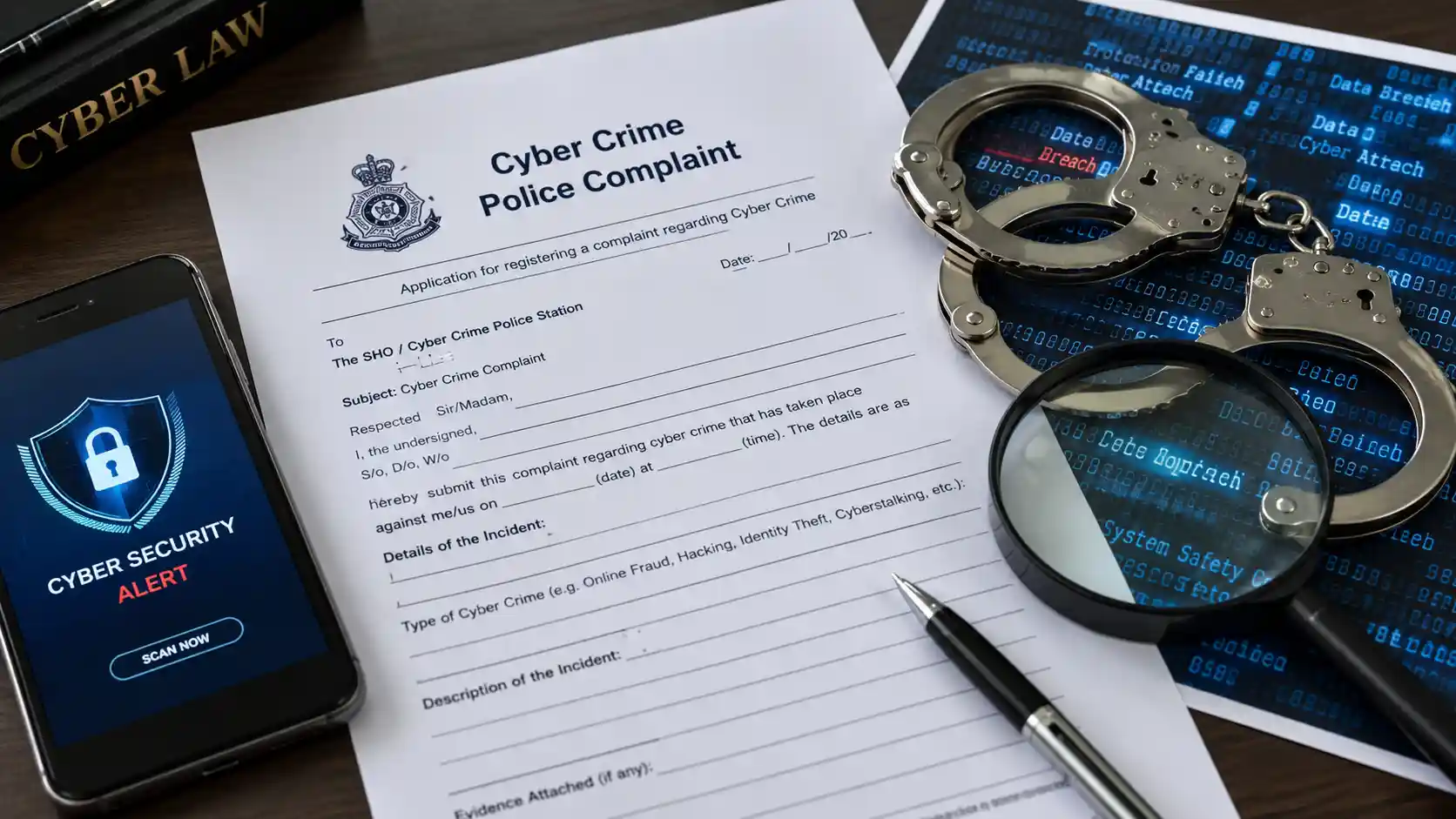
Digital payments and digital banking have transformed everyday transactions across India. From instant PhonePe/Google Pay UPI transfers to seamless credit card checkouts, digital finance has made life effortlessly convenient. However, this digital revolution has also birthed a rising wave of sophisticated cyber financial crimes.
Every single day, thousands of unsuspecting citizens fall victim to QR code scanning frauds, fake part-time job/investment scams, OTP frauds, impersonation calls from fake police/CBI officers ("digital arrest" scams), and fraudulent e-commerce websites.
If you or someone you know has been cheated online, every second counts. Acting quickly within the initial few hours—known in law enforcement as the "Golden Hours"—drastically increases the probability of freezing the stolen funds in the fraudster's bank account or digital wallet before they cash it out.
In this practical, action-oriented legal guide, we explain the step-by-step process of reporting cyber financial fraud in India, highlight the 1930 Helpline and cybercrime.gov.in portal procedures, provide two free downloadable application formats (for the Police/Cyber Crime Station and your Bank), and list the critical evidence documents required for quick fund recovery.
The Critical "Golden Hours": What to Do in the First 2 Hours
The single biggest mistake victims of online financial fraud make is waiting or delaying action out of embarrassment or panic. Cyber fraudsters move stolen money across multiple "mule accounts" within minutes using automated bots and UPI transfers.
If you lose money in an online fraud, execute these 3 steps immediately within the first 2 hours: [1. Dial National Cyber Crime Helpline 1930] ➔ [2. Call Your Bank to Freeze Account/Card] ➔ [3. File Written Complaint at Cyber Cell]
Step 1: Call the National Cyber Crime Helpline (1930) Immediately
Dial 1930 (formerly 155260) from your registered mobile number. This central helpline is operated by the Citizen Financial Cyber Fraud Reporting and Management System under the Indian Cyber Crime Coordination Centre (I4C), Ministry of Home Affairs.
When you call, provide the operator with:
- Your Name and Registered Mobile Number.
- Bank Account Number / UPI ID from which money was debited.
- Beneficiary Bank Account Number / UPI ID or Transaction Reference Number (UTR).
- Transaction Date, Time, and Exact Amount.
The 1930 system immediately issues a temporary "block request" to the recipient bank or wallet service (like Paytm, Razorpay, or PhonePe) to hold the stolen funds in the fraudster's account.
Step 2: Inform Your Home Bank
Call your bank’s toll-free customer care line immediately to block your debit/credit card, disable internet banking, or temporarily freeze your UPI services to prevent further unauthorized debits.
Step 3: Register an Official Portal Complaint
Visit the official Indian government portal: cybercrime.gov.in and submit an online financial complaint ticket to generate a formal Complaint Acknowledgment Number.
Application Format 1: Written Police Complaint / Cyber Crime Cell Application
Use this format to file a physical written complaint at your local Police Station or dedicated Cyber Crime Police Station. Ensure you print two copies—one to submit and one to receive an official stamped acknowledgment.
To, The Officer-in-Charge / Inspector of Police, [Cyber Crime Police Station / Local Police Station Name] [City / District Name, State] [PIN Code]
Date: [Insert Date]
SUBJECT: Complaint regarding online financial fraud/cyber crime amounting to Rs. [Amount] via [UPI/Credit Card/Net Banking] - Reg.
Respected Sir/Madam,
I am writing to lodge a formal complaint regarding an act of cyber financial crime and cheating committed against me on [Date of Incident].
1. Particulars of the Complainant:
- Full Name: [Your Full Legal Name]
- Father’s / Husband’s Name: [Insert Name]
- Residential Address: [Your Complete Postal Address]
- Mobile Number: [+91-XXXXXXXXXX]
- Email ID: [Your Email Address]
- Aadhaar Number: [XXXX-XXXX-XXXX]
2. Details of Victim’s Bank Account:
- Bank Name & Branch: [e.g., State Bank of India, Main Branch]
- Account Number: [Your Account Number]
- UPI ID / Debit Card Number: [Your UPI ID / Card Details]
3. Summary of the Fraudulent Incident: On [Date] at approximately [Time, e.g., 11:30 AM], I was contacted by an unknown person via [Phone Call / WhatsApp / Telegram] from mobile number [Fraudster's Mobile Number]. The caller fraudulently identified themselves as [explain fake identity, e.g., Bank Executive / Customer Care Representative / Courier Executive / Buyer].
Under the pretext of [explain modus operandi, e.g., updating KYC / reversing a wrong payment / part-time job task refund / receiving money via QR code], the fraudster induced me to [explain action, e.g., click a malicious link / scan a QR code / enter my UPI PIN / share an OTP].
Immediately thereafter, an amount of Rs. [Amount in Figures]/- (Rupees [Amount in Words] Only) was fraudulently debited from my bank account without my valid consent in the following transaction(s):
Date & Time Transaction ID / UTR No. Debited Amount Beneficiary Bank / VPA Details [DD/MM/YYYY HH:MM] [Insert 12-digit UTR] Rs. [Amount] [Fraudster's Account/UPI ID] 4. Actions Taken Post Incident:
- I reported the incident immediately on the National Cyber Crime Helpline 1930 on [Date & Time] under Reference Acknowledgement No. [Insert 1930 Ack Number].
- I filed an online complaint on cybercrime.gov.in vide Acknowledgement Number [Insert Portal Ack Number].
- I informed my home bank to temporarily block my account/card.
5. Prayer / Request: In light of the above facts, I humbly request you to: a) Register a Formal Complaint / FIR against the unknown fraudster(s) under relevant sections of the Information Technology Act, 2000 and the Bharatiya Nyaya Sanhita (BNS) / IPC. b) Direct the concerned bank/intermediary wallet to freeze the beneficiary account and initiate recovery/lien creation on the fraudulent funds. c) Help me recover my hard-earned money.
I have attached all documentary evidence including bank statements, WhatsApp chat screenshots, transaction receipts, and call logs for your investigation.
Yours faithfully,
(Signature) [Your Full Name] [Contact Number]
Enclosures:
- Copy of Bank Account Statement highlighting the fraudulent debit(s).
- Screenshots of WhatsApp/Telegram conversations and SMS alerts.
- Screenshot of Call Log showing fraudster's mobile number.
- Copy of National Cyber Crime Portal Complaint Acknowledgement Slip.
- Copy of ID Proof (Aadhaar Card / PAN Card).
Application Format 2: Immediate Bank Intimation Letter for Account Lien / Chargeback
In addition to filing a police complaint, you must immediately submit a written application to your Home Bank Branch Manager to request a formal dispute / chargeback and ask them to place a lien on the fraudster's beneficiary account via the NPCI network.
To, The Branch Manager, [Name of Your Home Bank, e.g., ICICI Bank] [Branch Address] [City, State, PIN Code]
Date: [Insert Date]
SUBJECT: Intimation of Unauthorized Online Transaction / Request for Dispute Chargeback & Lien Creation on Beneficiary Account
Respected Sir/Madam,
I maintain a Savings Account bearing Number [Insert Account Number] with your branch.
I am writing to urgently report unauthorized financial fraud transactions that occurred on my account on [Date] between [Start Time] and [End Time], totaling Rs. [Total Stolen Amount]/-.
Details of the fraudulent transaction(s) are as follows:
- Transaction Date & Time: [DD/MM/YYYY at HH:MM]
- Transaction Reference Number (RRN/UTR): [Insert 12-digit UTR Number]
- Amount Debited: Rs. [Amount]/-
- Destination Account / VPA ID: [Fraudster's Account or UPI ID]
As per the RBI Circular on "Customer Protection – Limiting Liability of Customers in Unauthorised Electronic Banking Transactions" (RBI/2017-18/15 DBR.No.Leg.BC.78/09.07.005/2017-18), zero/limited liability applies when unauthorized transactions are reported to the bank without delay.
I have already lodged an official complaint on the National Cyber Crime Portal (Ack No: [Insert Ack No]) and called Helpline 1930.
I request you to urgently mark a dispute/chargeback in the NPCI/NFS system, coordinate with the destination bank to freeze the beneficiary account, and credit the disputed amount back to my account as per RBI customer protection norms.
Thanking you.
Yours sincerely,
(Signature) [Your Full Name] [Account Number] [Mobile Number]
Essential Evidence Checklist to Attach with Your Complaint
When submitting a cyber crime complaint to the police or uploading details to cybercrime.gov.in, gather and organize these key evidence documents:
| Evidence Type | What to Collect & Print | Why It Is Crucial |
|---|---|---|
| Bank Evidence | Official Bank Statement or Passbook copy highlighting debits. | Proves physical loss of funds from your account. |
| Transaction Proof | Payment screenshots showing 12-digit UTR / Transaction ID / RRN. | Allows police to track the exact money flow path via NPCI. |
| Digital Evidence | Full-page screenshots of WhatsApp/Telegram chats, emails, or fake websites. | Establishes the fraudster's modus operandi and fake identities. |
| Communication Records | Phone call logs showing caller number, date, time, and call duration. | Used by police to pull Call Detail Records (CDR) from telecom operators. |
| 1930 & Portal Proof | Copy of acknowledgement SMS from 1930 helpline and portal PDF ticket. | Confirms you acted within the statutory timeline. |
Key Legal Sections in Indian Cyber Fraud Cases
When police file an FIR or investigation report for online financial fraud, the following sections under Indian law are typically applied:
- Section 66C of IT Act, 2000: Punishment for identity theft (using another person's password, digital signature, or unique identification feature).
- Section 66D of IT Act, 2000: Punishment for cheating by personation by using a computer resource or mobile device (imprisonment up to 3 years and fine).
- Section 318 of BNS (formerly IPC Section 420): Cheating and dishonestly inducing delivery of property.
- Section 319 of BNS (formerly IPC Section 419): Punishment for cheating by personation.
5 Critical Golden Rules to Prevent Online Cyber Scams
- "UPI PIN is ONLY for Paying Money, NOT Receiving Money": Remember this cardinal rule. You never need to scan a QR code or enter your 4/6 digit UPI PIN to receive money into your account.
- Never Allow Remote Access Apps: Never download apps like AnyDesk, TeamViewer, or RustDesk upon the instruction of an unknown caller. These apps grant complete remote control of your phone screen to scammers.
- Verify "Digital Arrest" Scams: Real law enforcement agencies (Police, CBI, Enforcement Directorate, Customs) never arrest anyone over Skype/WhatsApp video calls or demand money to clear investigation cases.
- Avoid Unknown APK Files: Never install
.apkfiles sent via WhatsApp or Telegram promising part-time jobs, instant loans, or courier tracking updates. - Cross-Check Customer Care Numbers: Never search for customer service phone numbers on Google Search ads. Always find official numbers from the official app or bank website.
Conclusion
Facing an online financial scam is traumatic, but swift, methodical legal action is your best defense. By dialing 1930 immediately, filing an online complaint on cybercrime.gov.in, and submitting written application formats to your local Cyber Cell and Bank Manager, you enforce your statutory rights and maximize the chances of recovering your funds.
*Disclaimer: This blog post and downloadable complaint templates are provided strictly for