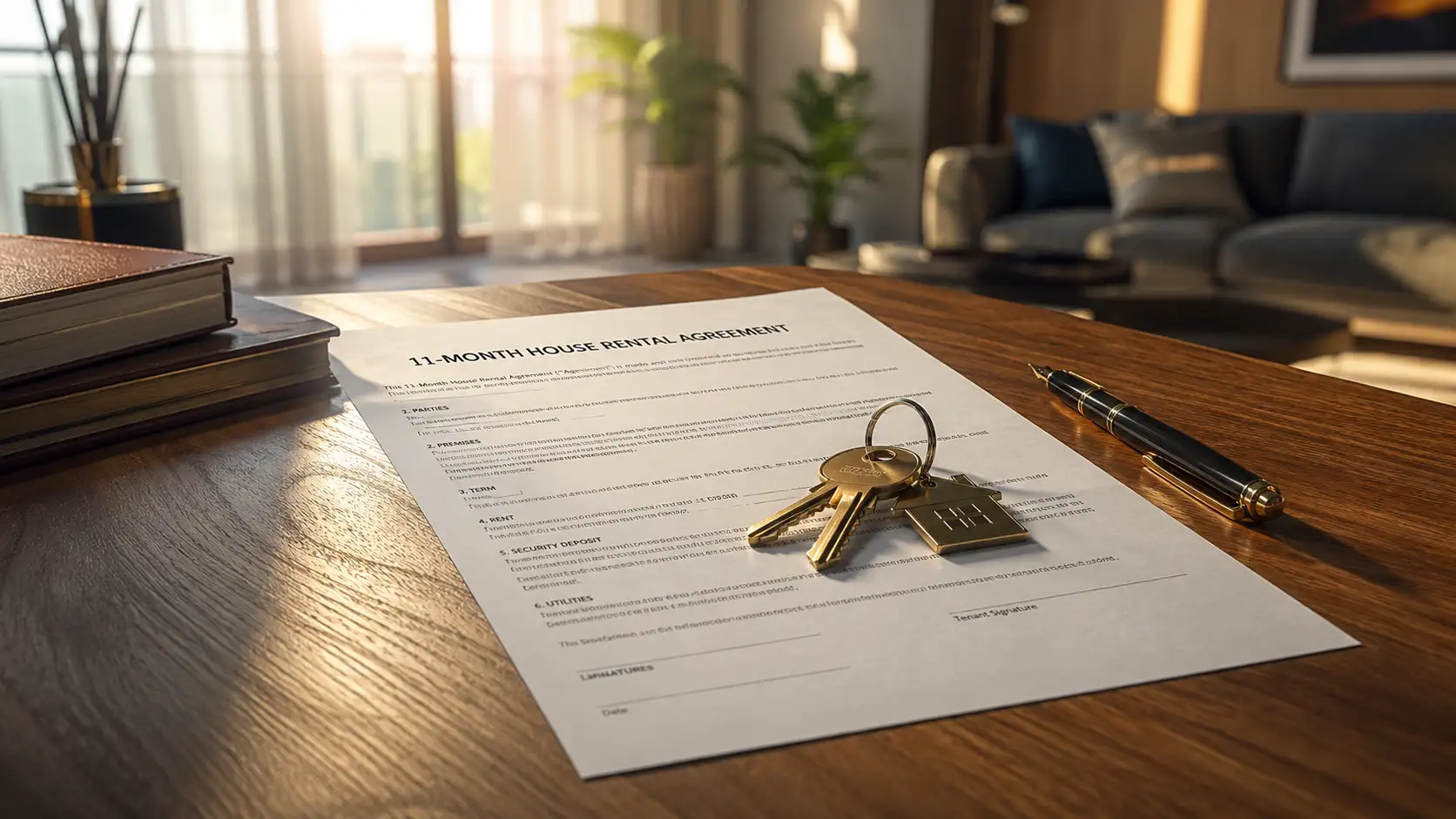
Renting a residential property in India—whether you are a property owner letting out your flat or a working professional relocating to a new metro city—can rapidly turn into a legal nightmare if your rental contract is vague, informal, or legally incomplete. Disputes regarding unrefunded security deposits, sudden rent hikes, unexpected eviction threats, and maintenance disputes are rampant across Indian cities like Bangalore, Mumbai, Delhi-NCR, Hyderabad, Pune, and Kolkata.
An airtight House Rent Agreement (or Leave and License Agreement) protects both landlords and tenants against future litigation. Beyond preventing conflicts, a valid rental agreement serves as official proof of address for bank accounts, passport updates, broadband connections, and gas cylinder registration.
In this exhaustive legal guide, we break down why standard rent agreements in India are executed for exactly 11 months, list the 10 mandatory clauses every contract must contain, explain stamp duty and notarization requirements across major states, and provide a free, ready-to-use 11-Month House Rent Agreement Draft that you can copy, customize, and print on e-stamp paper.
Why Are Most Rent Agreements in India Made for Exactly 11 Months?
If you have ever rented a home in India, you have likely wondered why almost every residential rental agreement carries a validity period of 11 months. This is not an arbitrary rule; it is a calculated legal workaround designed to navigate Indian property statutes efficiently.
1. Section 17 of the Registration Act, 1908
Under Section 17 of the Registration Act, 1908, any lease or tenancy agreement for immovable property that exceeds a duration of 12 months (1 year) must be mandatorily registered at the local Sub-Registrar's office. Registering a lease deed involves paying significant stamp duty charges and registration fees, which typically range between 1% and 5% of the total annual rent plus security deposit.
2. Saving High Stamp Duty & Sub-Registrar Registration Fees
By capping the tenancy agreement at 11 months, both landlord and tenant legally bypass the statutory requirement for compulsory registration at the Sub-Registrar office. An 11-month contract can simply be printed on non-judicial e-stamp paper and notarized by a Public Notary, saving both parties thousands of rupees and hours of bureaucratic hassle.
3. Exemption from Archaic State Rent Control Acts
Lease contracts extending beyond 12 months often fall under state-specific Rent Control Acts (such as the Delhi Rent Control Act or Maharashtra Rent Control Act). These laws are historically heavily biased toward tenants, making it notoriously difficult for property owners to evict defaulting tenants or adjust rent to fair market rates. An 11-month contract establishes a temporary licensor-licensee relationship, granting permissive possession rather than permanent tenancy rights.
Important Caveat: While 11-month notarized agreements are valid across most of India, states like Maharashtra mandate online registration of all Leave and License agreements regardless of the tenure under Section 55 of the Maharashtra Rent Control Act, 1999.
Lease Agreement vs. Leave and License Agreement
Understanding the distinction between a Lease and a Leave and License Agreement is essential when drafting property contracts in India:
| Feature | Lease Agreement | Leave and License Agreement |
|---|---|---|
| Legal Nature | Transfer of interest in the property. | Grant of permission (license) to occupy without interest transfer. |
| Governing Law | Transfer of Property Act, 1882. | Indian Easements Act, 1882 (Section 52). |
| Standard Duration | 12 months, 3 years, 5 years, or long-term. | Typically 11 months (renewable). |
| Registration Requirement | Mandatory registration under Section 17. | Optional (except in states like Maharashtra). |
| Eviction Mechanism | Complex, requiring civil court litigation. | Comparatively simple upon notice period expiry. |
| Sub-Letting | Allowed unless explicitly restricted. | Strictly prohibited by default. |
10 Mandatory Clauses Every Rent Agreement Must Include
Before signing any tenancy document, verify that these 10 crucial legal clauses are included in your draft to prevent future legal disputes:
- Complete Party Identifications: Full legal names, permanent residential addresses, Aadhaar numbers, and PAN details of both Landlord (Licensor) and Tenant (Licensee).
- Detailed Property Description: Full postal address of the property, flat number, floor, building name, street, municipal ward, city, pin code, and designated parking space details.
- Monthly Rent & Due Date: The exact monthly rental figure (in figures and words), mode of payment (UPI, NEFT, IMPS, or Cheque), and fixed due date (e.g., on or before the 5th of every calendar month).
- Security Deposit & Refund Conditions: Total interest-free refundable deposit paid, conditions for legitimate deductions (unpaid utility bills or structural damages), and a strict refund deadline (usually on the day of physical key handover).
- Lock-In Period Clause: A minimum binding period (typically 3 to 6 months) during which neither party can terminate the contract without incurring a financial penalty equal to the remaining lock-in period rent.
- Termination & Notice Period: A clear notice period requirement (usually 30 days or 1 month) for terminating tenancy after the lock-in period expires.
- Rent Escalation Clause: A pre-determined percentage increase in monthly rent (commonly 5% to 10%) if the agreement is renewed for another 11-month term.
- Utility Bills & Society Maintenance: Clear allocation of responsibilities regarding monthly apartment society maintenance fees, electricity bills, water charges, piped gas (PNG), and municipal property taxes.
- Repairs & Maintenance Responsibilities: Landlord covers major structural repairs, civil defects, and external seepage; Tenant handles minor day-to-day electrical fixes, plumbing tap replacements, and routine wear-and-tear items.
- Restriction on Commercial Use & Sub-Letting: Explicit prohibition against sub-renting the flat to third parties or using the residential premises for commercial, office, or illegal activities.
Free 11-Month House Rent Agreement Draft Format (English)
You can copy the legal draft below, fill in your specific details inside the brackets [ ... ], and print it directly on non-judicial e-stamp paper.
RENT AGREEMENT / LEAVE AND LICENSE AGREEMENT
This Rent Agreement is made and executed on this [Day] day of [Month], 20[Year] at [City Name, State] by and between:
LESSOR / LICENSOR (LANDLORD): Mr./Ms. [Full Name of Landlord], Son/Daughter/Wife of [Father's/Husband's Name], Permanent Address: [Complete Permanent Address], Aadhaar Number: [XXXX-XXXX-XXXX] | PAN: [ABCDE1234F] Mobile Number: [+91-XXXXXXXXXX] (Hereinafter referred to as the "FIRST PARTY / LICENSOR / OWNER", which expression shall unless excluded by or repugnant to the context include his/her legal heirs, executors, administrators, and assigns).
AND
LESSEE / LICENSEE (TENANT): Mr./Ms. [Full Name of Tenant], Son/Daughter/Wife of [Father's/Husband's Name], Permanent Address: [Complete Permanent Address], Aadhaar Number: [XXXX-XXXX-XXXX] | PAN: [ABCDE1234F] Mobile Number: [+91-XXXXXXXXXX] (Hereinafter referred to as the "SECOND PARTY / LICENSEE / TENANT", which expression shall unless excluded by or repugnant to the context include his/her legal heirs, executors, administrators, and assigns).
WHEREAS the First Party is the absolute legal owner and in lawful possession of the residential property situated at: [Complete Flat/House Address, Floor Number, Apartment Name, Locality, City, State - PIN Code] (hereinafter referred to as the "SCHEDULE PREMISES").
AND WHEREAS at the request of the Second Party, the First Party has agreed to grant on leave and license basis the Schedule Premises to the Second Party for residential purposes only, on the terms and conditions outlined below:
NOW THIS AGREEMENT WITNESSETH AND IT IS HEREBY MUTUALLY AGREED AS FOLLOWS:
1. DURATION OF AGREEMENT: The license shall be for a fixed period of 11 (Eleven) months commencing from [Start Date: DD/MM/YYYY] to [End Date: DD/MM/YYYY]. This agreement may be extended for a further period on mutually agreed terms through a fresh written contract.
2. MONTHLY RENT AND PAYMENT TERMS: a) The Second Party agrees to pay the First Party a monthly rent of Rs. [Amount in Numbers]/- (Rupees [Amount in Words] Only). b) The monthly rent shall be payable in advance on or before the [e.g., 5th] day of each English calendar month via Bank Transfer / UPI / IMPS to the First Party's bank account:
- Bank Name: [Insert Bank Name]
- Account Holder: [Insert Account Holder Name]
- Account Number: [Insert Account Number]
- IFSC Code: [Insert IFSC Code]
3. REFUNDABLE SECURITY DEPOSIT: a) The Second Party has paid an interest-free refundable Security Deposit of Rs. [Deposit Amount in Numbers]/- (Rupees [Deposit Amount in Words] Only) to the First Party via Transaction Ref No. [Insert Bank/UPI Ref No] dated [Insert Date]. b) The First Party shall refund this Security Deposit in full to the Second Party on the date of vacating and handing over vacant physical possession of the Schedule Premises, subject to deductions for any unpaid utility bills or structural damages (excluding natural wear and tear).
4. MAINTENANCE & UTILITY CHARGES: a) The Second Party shall directly pay electricity bills, water charges, internet, and piped gas charges as per actual meter readings to the respective service providers. b) The monthly apartment RWA / Society Maintenance Fee of Rs. [Maintenance Amount]/- shall be paid by the [First Party / Second Party] directly to the Resident Welfare Association.
5. LOCK-IN PERIOD AND TERMINATION: a) There shall be a mandatory Lock-in Period of [e.g., 3 or 6] months from the commencement date, during which neither party can terminate this agreement. b) After the expiry of the Lock-in Period, either party may terminate this agreement by providing 1 (One) month's written notice or 1 month's rent in lieu of notice to the other party.
6. USE OF PREMISES & SUB-LETTING: a) The Schedule Premises shall be used exclusively for residential purposes by the Second Party and their immediate family members. b) The Second Party shall not sub-let, assign, or transfer the premises or any part thereof to any third party under any circumstances. c) The Second Party shall not store hazardous materials or engage in unlawful or immoral activities inside the premises.
7. REPAIRS AND INSPECTION: a) Major structural repairs, building leakage, or external pipe failures shall be attended to by the First Party. Day-to-day maintenance and minor electrical/plumbing repairs shall be borne by the Second Party. b) The First Party shall have the right to inspect the premises during reasonable daylight hours with prior 24-hour notice to the Second Party.
8. INVENTORY OF FITTINGS & FIXTURES: The Second Party acknowledges receipt of the following fixtures in working condition:
- Ceiling Fans: [Count] | LED Tube Lights: [Count] | Geysers: [Count]
- AC Units: [Count] | Water Purifier: [Count] | Wooden Wardrobes: [Count]
IN WITNESS WHEREOF, the parties hereto have signed this Rent Agreement on the day, month, and year first written above in the presence of the following witnesses:
____________________________________ ____________________________________ FIRST PARTY (LICENSOR / OWNER) SECOND PARTY (LICENSEE / TENANT)
WITNESSES:
- Signature: _______________________ 2. Signature: _______________________ Name: __________________________ Name: __________________________ Address: ________________________ Address: ________________________ Aadhaar No: ____________________ Aadhaar No: ____________________
Stamp Paper Requirements State-Wise in India
To make your rental agreement legally enforceable in court, you must execute it on non-judicial stamp paper (or e-Stamp paper) of adequate denomination as prescribed by state stamp acts:
- Karnataka: Rs. 100 or Rs. 200 non-judicial e-stamp paper for 11 months.
- Delhi / NCR: Rs. 50 or Rs. 100 non-judicial stamp paper.
- Maharashtra: Stamp duty is calculated at 0.25% of total annual rent + deposit. Online e-registration is mandatory.
- West Bengal: Rs. 50 or Rs. 100 non-judicial stamp paper.
- Tamil Nadu: Rs. 20 to Rs. 100 stamp paper for 11-month tenure.
Notarization Procedure
Once the agreement is printed on e-stamp paper, both Landlord and Tenant must sign every page in the presence of two independent witnesses. A licensed Notary Public will verify Aadhaar identification cards, apply notary seals, and record the document entry in their official legal register.
5 Critical Pitfalls to Avoid in Rental Agreements
- Paying Cash Security Deposits: Avoid cash payments for security deposits. Always use traceable banking channels (UPI, NEFT, or Account Payee Cheques) to retain verifiable proof of payment.
- Skipping the Inventory Checklist: Failing to document pre-existing property damages (wall cracks, plumbing leaks, chipped tiles) often leads to unwarranted deductions from your deposit when moving out.
- Ignoring Tenant Police Verification: In Indian metro cities, Tenant Police Verification is legally mandatory. Failure to submit tenant details to local police stations can attract criminal proceedings against property owners under Section 188 of the Indian Penal Code (IPC).
- Vague Maintenance Definitions: Ensure the contract clearly distinguishes between basic RWA society maintenance fees and special capital development funds demanded by housing societies.
- Omitting Lock-In Penalty Specifics: Without explicit lock-in penalty terms, property owners struggle to forfeit security deposits legally if tenants vacate prematurely.
Overview of the Model Tenancy Act (MTA), 2021
To modernize India's rental housing sector, the Ministry of Housing and Urban Affairs drafted the Model Tenancy Act (MTA). Key features being implemented by various states include:
- Cap on Security Deposit: Maximum 2 months' rent for residential properties and 6 months' rent for commercial properties.
- 24-Hour Entry Notice: Landlords must provide at least 24 hours' prior written or electronic notice before entering the rented property.
- Special Rent Courts: Dedicated Rent Authorities and Rent Tribunals for fast-track dispute resolution within 60 days.
Conclusion
A clearly articulated 11-month House Rent Agreement acts as the ultimate safeguard for both landlords and tenants against unexpected legal entanglements and financial losses. Always ensure your rental document is printed on prescribed non-judicial e-stamp paper, witnessed by two independent individuals, notarized, and accompanied by police verification.
Disclaimer: This guide and template are provided strictly for educational and informational purposes. Stamp duty laws and tenancy regulations vary across Indian states. Consult a qualified legal practitioner or advocate for specific property transactions.