Picture this common scenario: You lent a substantial sum of money to a friend or business associate who promised faithfully to pay you back within three months. Six months pass, then a year. Every time you ask for your money, you receive endless excuses, unfulfilled promises, or outright ignored calls.
Or consider another familiar situation: You resigned from your job after serving your full notice period, but your former employer has been withholding your Full and Final (F&F) settlement and salary for over four months without any valid reason.
When polite reminders and phone calls stop working, jumping straight into a court lawsuit can feel overwhelming and expensive. This is where a Legal Notice serves as your most powerful first step.
A Legal Notice is a formal written communication sent by an aggrieved party warning the opposing party of impending legal action if a specific dispute is not settled within a given deadline (usually 15 to 30 days).
In Indian civil jurisprudence, a well-drafted legal notice acts as a serious warning shot. It demonstrates to the opposing party that you are prepared to take the matter to a court of law. In fact, over 60% of civil disputes, unpaid debt issues, and contractual breaches in India are resolved right after a legal notice is served, without ever stepping inside a courtroom.
In this ultimate guide, we explain when you need a legal notice, whether you can send one yourself without paying high lawyer fees, provide two free ready-to-use Legal Notice formats (for Money Recovery and Unpaid Salary), and share step-by-step delivery instructions.
What is a Legal Notice and Why is it Necessary?
A Legal Notice is an official document served under civil law principles (and specific statutes like Section 80 of the Code of Civil Procedure, Section 138 of the Negotiable Instruments Act, or Section 106 of the Transfer of Property Act).
It serves three main legal purposes:
- Formal Intention to Sue: It officially informs the recipient (the defaulter or wrongdoer) that you intend to initiate formal civil litigation against them.
- Opportunity for Amicable Settlement: It grants the recipient a final grace period (typically 15 to 30 days) to fulfill their contractual or financial obligations without facing legal fees and court proceedings.
- Crucial Documentary Evidence in Court: When you eventually file a lawsuit, court judges always examine the legal notice and the recipient's reply (or silence) to establish who attempted to resolve the dispute honestly.
Common Cases Where Sending a Legal Notice is Essential
[Contract Breach / Unpaid Debt] ➔ [Draft Legal Notice] ➔ [Send via Speed Post with AD] ➔ [15-Day Grace Period] ➔ [Settlement or Civil Lawsuit]
- Recovery of Money: Unpaid loans, unpaid business invoices, bounced cheques (Sec 138 NI Act), or outstanding client dues.
- Employer-Employee Disputes: Non-payment of salary, withheld PF, illegal termination, or refusal to issue service/experience certificates.
- Landlord-Tenant Matters: Unpaid rent, failure to refund security deposit, refusal to vacate property after lease expiry (Sec 106 Transfer of Property Act).
- Breach of Contract: Failure to complete construction projects, vendor default, or breaking terms of a signed service agreement.
- Property & Family Partition Disputes: Unauthorized encroaching on land, ancestral property partition demands, or family settlement defaults.
Do You Need an Advocate to Send a Legal Notice?
Here is a common misconception: Many people believe that only an advocate enrolled with a State Bar Council can write or issue a legal notice.
The legal reality: While an advocate's letterhead carries professional authority, any citizen in India can legally draft and send a personal Legal Demand Notice directly to an individual or company.
If your financial claim is straightforward (such as recovering a personal loan or unpaid salary), sending a well-drafted personal legal notice via Speed Post is 100% legally valid and often achieves the exact same result without spending ₹5,000 to ₹15,000 on advocate drafting charges.
Key Ingredients of an Effective Legal Notice
Whether you draft the notice yourself or through an advocate, ensure it contains these six essential components:
- Clear Header & Identification: Complete name, postal address, and contact details of both the Sender (You) and the Recipient (Opposite Party).
- Chronological Statement of Facts: Clear, step-by-step timeline detailing how the agreement occurred, what money was paid, and when the default happened.
- Specific Allegation of Breach: Explicitly state how the recipient's actions caused you financial loss, mental harassment, or contractual damage.
- Specific Legal Remedy / Demand: Clearly specify the exact monetary amount or action demanded (e.g., "Pay ₹1,500,000 plus 12% annual interest").
- Mandatory Timeline for Compliance: Give a strict deadline—typically 15 calendar days from receipt of the notice.
- Consequence of Default Warning: State clearly that failure to comply within the deadline will result in immediate civil/criminal court proceedings at the recipient's cost.
Template 1: Legal Notice Format for Money Recovery (Unpaid Debt / Loan)
Use this draft if an individual or firm owes you money for a personal loan, unpaid invoice, or unreturned security deposit.
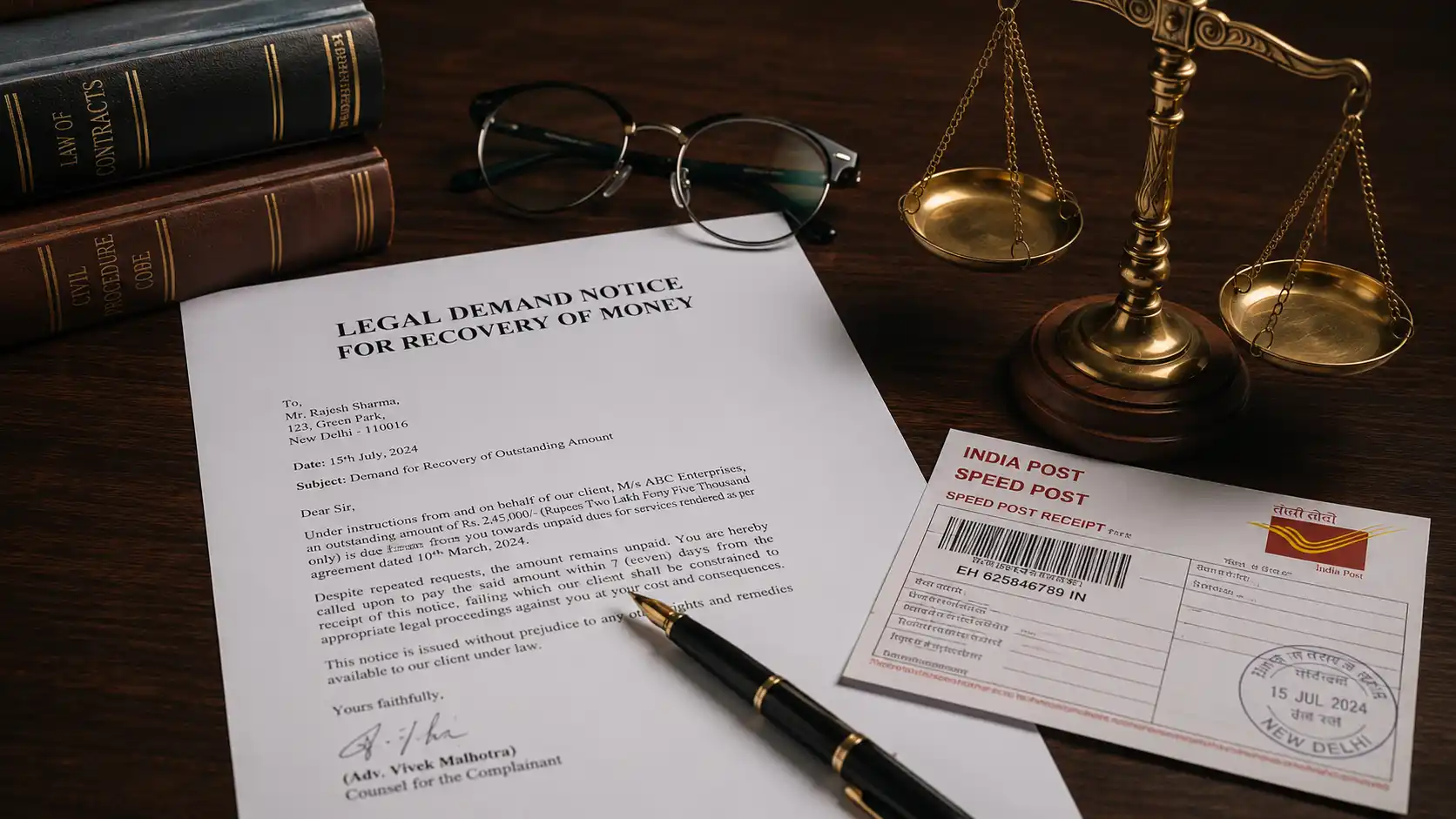
DEMAND NOTICE FOR RECOVERY OF MONEY
REGISTERED POST WITH ACKNOWLEDGEMENT DUE / SPEED POST
Date: [Insert Date]
TO: [Full Name of Defaulter / Recipient] S/o: [Father's Name of Recipient] Resident of: [Complete Residential Address of Recipient] Mobile: [+91-XXXXXXXXXX] | Email: [Recipient Email]
FROM: [Your Full Legal Name] S/o, D/o: [Your Father's Name] Resident of: [Your Complete Postal Address] Mobile: [+91-XXXXXXXXXX] | Email: [Your Email]
SUBJECT: Legal Notice for recovery of outstanding principal amount of ₹[Insert Amount] along with interest @ 12% per annum.
Sir/Madam,
Under instructions from myself, I hereby serve upon you this formal Legal Demand Notice:
That you and I have known each other since [Year/Date] as [describe relationship, e.g., business partners / close acquaintances].
That on [Date of Loan/Transaction], you approached me requesting a temporary financial loan of ₹[Insert Principal Amount]/- for [state purpose given, e.g., business cash flow / personal emergency], promising to repay the complete sum within [e.g., 3 months] on or before [Promised Repayment Date].
That believing your assurance, I transferred the total sum of ₹[Amount]/- to your bank account bearing No. [Account Number] via [NEFT / UPI / Cheque No.] on [Transaction Date] (Transaction Receipt attached as Annexure A).
That despite the expiry of the promised period on [Promised Date], you failed to repay the agreed amount. Upon repeated follow-up phone calls and reminders on [Dates], you issued evasive responses and failed to clear your lawful debt.
That your intentional failure to return my hard-earned money constitutes criminal breach of trust and unlawful enrichment at my expense, causing me severe financial loss and mental harassment.
DEMAND: I hereby call upon you to pay the entire principal amount of ₹[Insert Amount]/- together with interest @ 12% per annum calculated from [Due Date] till actual payment, within 15 (Fifteen) Days from the date of receipt of this notice.
Please note that if you fail to comply with this demand within the stipulated period of 15 days, I shall be constrained to initiate appropriate civil proceedings for recovery under Order 37 of the Code of Civil Procedure, 1908 (Summary Suit), as well as criminal proceedings under the applicable laws of India, entirely at your risk, costs, and consequences.
Place: [Your City] Date: [Insert Date]
SENDER (Signature) [Your Full Legal Name]
Template 2: Legal Notice Format to Employer for Unpaid Salary & F&F Settlement
Use this draft if your previous company has unfairly withheld your salary, incentive dues, or Full and Final settlement after resignation.
LEGAL NOTICE FOR NON-PAYMENT OF SALARY & FULL AND FINAL SETTLEMENT
BY SPEED POST & REGISTERED EMAIL
Date: [Insert Date]
TO: The Managing Director / Human Resources Head, [Company Name Pvt. Ltd.] Corporate Address: [Complete Office Address] Email ID: [Official HR & Director Email Addresses]
FROM: [Your Full Name] Former Employee ID: [Your Employee Code] Address: [Your Residential Address] Mobile: [+91-XXXXXXXXXX] | Email: [Your Email]
SUBJECT: Final Legal Notice for immediate release of pending salary dues and Full & Final Settlement amounting to ₹[Insert Sum].
Sir/Madam,
This notice is served upon your company regarding the illegal withholding of my earned salary and statutory dues:
That I was employed with your company, [Company Name], as [Your Designation] from [Joining Date] to [Last Working Date] under Employee ID [ID Number].
That I tendered my resignation on [Resignation Date] and served the complete contractual notice period of [e.g., 30 days] up to [Last Working Day]. I duly completed the formal clearance process and handed over all company assets and handovers on [Clearance Date] (Clearance Copy attached).
That as per your Employment Offer Letter Clause [X] and standard labor regulations, the company was legally obligated to settle my Full and Final (F&F) account within 30 to 45 days from my last working date, i.e., on or before [Expected Payment Date].
That despite the passage of [Number of months] months and multiple email communications dated [List Email Dates], your organization has failed to release my unpaid salary for [Month 1, Month 2] and my pending F&F settlement totaling ₹[Insert Total Dues Amount]/-.
DEMAND: I hereby demand that your organization release my entire outstanding dues of ₹[Amount]/-, along with my official Service / Experience Certificate and Relieving Letter, within 15 (Fifteen) Days of receiving this notice.
If your organization fails to settle these dues within 15 days, I will be compelled to approach the Labor Commissionerate, file a suit before the Labor Court under the Payment of Wages Act, and initiate proceedings under the Companies Act for corporate default, holding your organization liable for all legal expenses incurred.
Place: [Your City] Date: [Insert Date]
SENDER (Signature) [Your Full Name]
Step-by-Step Instructions to Send Your Legal Notice
Sending a legal notice correctly is just as crucial as drafting it properly:
[Print Notice on A4 Paper] ➔ [Sign Every Page] ➔ [Dispatch via India Post Speed Post with AD] ➔ [Track & Download Delivery Proof]
- Print and Sign: Print two physical copies on high-quality A4 paper. Sign at the bottom of every page in blue ink.
- Attach Supporting Documents: Attach clear photocopies of relevant bank statements, receipts, emails, or contract agreements as annexures.
- Dispatch via India Post Speed Post / Registered Post AD: Always send the primary copy using India Post Speed Post with Acknowledgement Due (AD) or Registered Post. Avoid unverified private couriers for legal notices.
- Send a Digital Copy via Email: Simultaneously email a PDF copy of the signed notice to the recipient's official email address. State in the email body: "Serving copy of Legal Notice dispatched today via Speed Post Tracking No: [Tracking ID]".
- Preserve Proof of Delivery: Track the Speed Post package on
indiapost.gov.in. Download and print the official delivery report showing "Item Delivered". Staple this delivery proof together with your office copy of the notice.
What Happens After the Legal Notice is Delivered?
Once the notice reaches the recipient, three possible outcomes occur:
| Outcome | What Happens Next | Recommended Strategy |
|---|---|---|
| Recipient Settles (Best Case) | Recipient pays dues or completes the action within 15 days. | Execute a written settlement deed and close the matter permanently. |
| Recipient Sends Reply Notice | Recipient’s lawyer sends a formal counter-reply disputing facts. | Evaluate their legal defense with a lawyer before deciding whether to proceed to court. |
| Recipient Ignores Notice | 15-day deadline expires with zero response or compliance. | Proceed to file a Summary Suit (Order 37 CPC), Labor Court complaint, or Civil Case immediately. |
5 Critical Drafting Mistakes to Avoid
- Writing Unrealistic Compensation Claims: Stick to actual financial losses plus reasonable interest and costs. Exaggerated claims weaken your credibility in court.
- Missing Proof of Transaction: Never claim money without attaching documented proof (bank transfer receipts, cheques, written promissory notes, or email acknowledgements).
- Forgetting Clear Deadlines: Always specify an exact timeframe (e.g., "15 days from date of receipt"). Vague statements like "pay as soon as possible" render a notice legally ineffective.
- Misspelling Names or Addresses: Ensure the recipient’s legal name and full physical postal address match official records (Aadhaar, PAN, corporate filings).
- Losing Speed Post Receipts: Courts require original postal booking receipts and official delivery status reports as primary proof of service under Section 27 of the General Clauses Act.
Conclusion
A legal notice is one of the most cost-effective and powerful remedies in civil law. It provides a structured, dignified channel to enforce your rights, recover hard-earned money, and resolve contractual defaults without immediately bearing the heavy time and financial burdens of full court litigation. By utilizing the free templates and dispatch guidelines in this guide, you can confidently protect your financial and legal interests.
*Disclaimer: This blog post and downloadable legal notice drafts are provided strictly for edu