Have you ever looked closely at your official documents and felt a sudden wave of panic? Your name is spelled "Rahul" on your Aadhaar card, but your PAN card says "Rahuul," and your 10th-grade mark sheet boldly declares "Rahul Kumar."
In India, a single misplaced alphabet in your name can turn your life upside down. It can stop your visa application, reject your home loan, freeze your provident fund (EPF) withdrawal, and create endless headaches during college admissions. And if you are a woman who has recently gotten married and wants to adopt your husband's surname, you already know the bureaucratic mountain standing in front of you.
When you ask for a solution, the standard government response is always the same: "Get a Name Change Affidavit made."
But what exactly goes into this document? How much stamp paper do you need? And is just getting an affidavit signed by a notary enough to change your name on your passport?
Take a deep breath. You do not need to pay a lawyer thousands of rupees to draft this simple document. In this comprehensive guide, we will break down the exact legal process of changing your name in India, explain the hidden traps, and provide you with free, legally vetted formats that you can use right away.
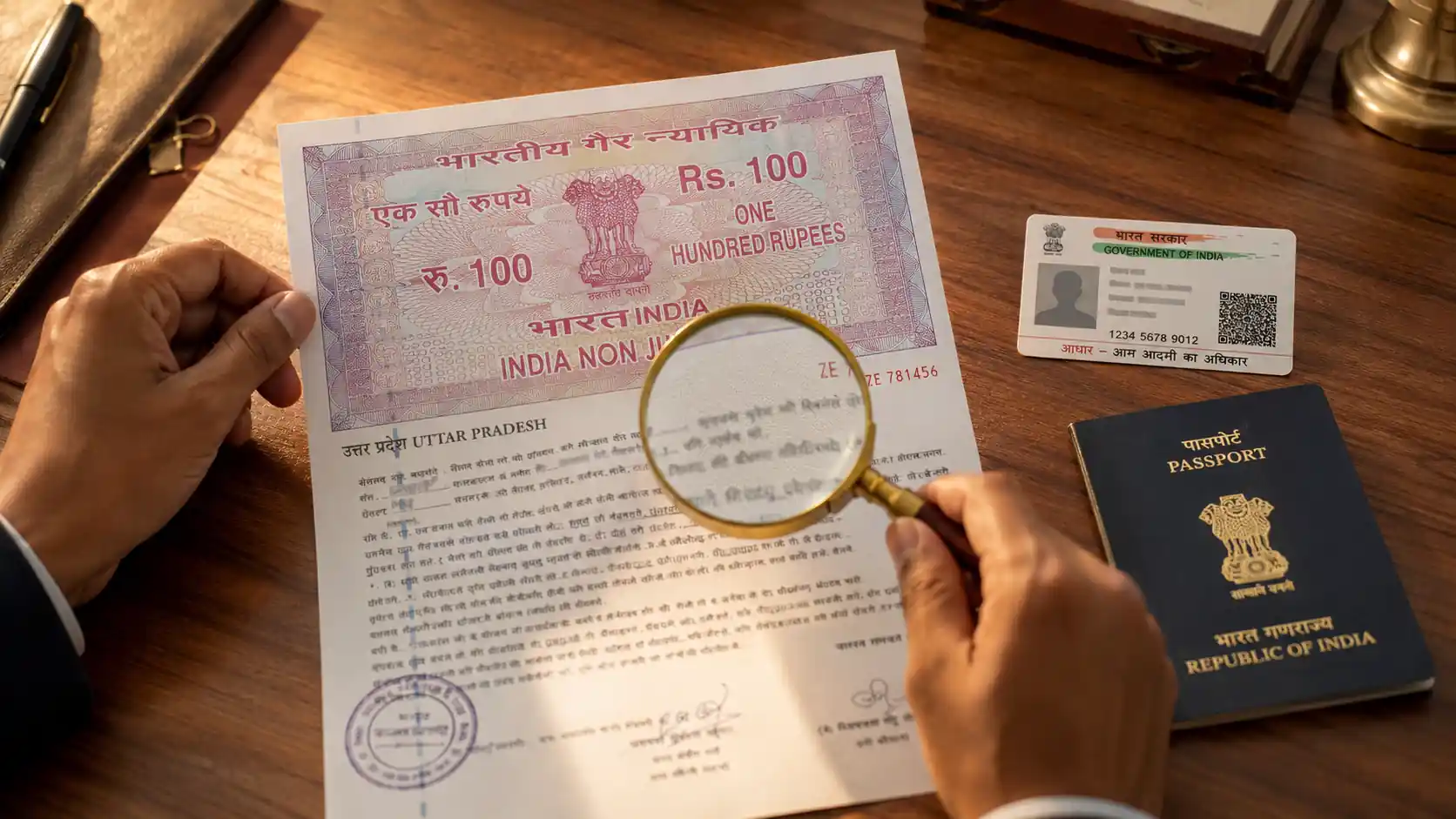
Why Do You Need a Name Change Affidavit?
An affidavit is a sworn statement made by you in front of an authorized legal officer (like a Notary Public or a Magistrate). By signing it, you are legally declaring that the facts stated inside the document are true. Lying on an affidavit is a punishable offense under the Indian Penal Code.
People in India typically need a name change affidavit for the following five reasons:
- Spelling Errors in Official IDs: This is the most common reason. A typo made by a data entry operator years ago on your Voter ID or Aadhaar card needs to be legally rectified.
- Marriage or Divorce: Traditionally, many Indian women change their surname after marriage. Conversely, after a divorce, many prefer to revert to their maiden name. Both require a sworn affidavit.
- Astrology and Numerology: Believe it or not, thousands of name changes happen every year because an astrologer suggested adding an extra 'K' or 'S' to bring good luck and prosperity.
- Change of Religion: If an individual converts to another religion and wishes to adopt a new name reflecting their new faith, the law mandates a formal name change process.
- Personal Preference: Sometimes, you just do not like the name your parents gave you. The law gives you the fundamental right to change it, provided you follow the proper legal procedure.
The 3-Step Master Process to Legally Change Your Name
Here is the biggest misconception most people have: They think getting a Notarised Affidavit is the end of the process.
Let me be very clear—if you want to change your name on highly secure documents like a Passport or a Bank Account, merely having an affidavit is not enough. You must complete a strict 3-step legal process mandated by the Government of India.
Step 1: Draft and Notarise the Name Change Affidavit
This is your starting point. You need to print your declaration on a Non-Judicial Stamp Paper (usually of ₹20 or ₹100 value, depending on your state) and get it attested by a Notary Public or an Oath Commissioner. This document acts as your primary legal proof of intention.
Step 2: Newspaper Publication
Once your affidavit is ready, you must publish an advertisement announcing your name change in two local daily newspapers.
- One must be in the local official language of your state (e.g., Bengali in West Bengal, Marathi in Maharashtra).
- The other must be in a national English daily (e.g., The Times of India, Hindustan Times).
- Pro Tip: Keep at least 10 original copies of these newspapers securely in a plastic folder. Do not cut out the ad snippet; you will need the full newspaper page showing the date as proof later.
Step 3: The Central Gazette Notification (The Ultimate Proof)
This is the final and most crucial step. The Central Government publishes an official magazine called the "Gazette of India" every week. You need to send your original affidavit, original newspaper copies, a CD containing your digital signature, and a government fee to the Department of Publication in New Delhi. Once your name change is published in the Gazette, it becomes the ultimate, undeniable legal proof. With a Gazette notification in your hand, no bank, embassy, or government office can ever question your new name.
Free Name Change Affidavit Formats
Drafting the affidavit is simple if you have the right template. Below are two widely accepted formats. You can copy the one that fits your exact situation, fill in your details, and take a printout on a Stamp Paper.
Format 1: Affidavit for Name Correction (Spelling Mistake / General Change)
Use this format if your name is spelled differently across various documents or if you are completely changing your name for personal or astrological reasons.
AFFIDAVIT FOR CHANGE OF NAME
I, [Your Old/Current Full Name], Son/Daughter/Wife of [Father's/Husband's Name], born on [Date of Birth], currently residing at [Your Complete Address as per Aadhaar], do hereby solemnly affirm and declare on oath as under:
- That my registered name in my birth certificate and older educational documents is [Your Old Name].
- That I have willingly and officially changed my name from [Your Old Name] to [Your New Name] with immediate effect.
- That I shall at all times hereafter in all records, deeds, and writings, and in all proceedings, dealings, and transactions, private as well as upon all occasions whatsoever, use and sign the name of [Your New Name] as my new name in place of my former name.
- That my old name [Your Old Name] and my new name [Your New Name] both represent the one and the same person, that is, myself.
- That I am executing this solemn declaration to be submitted to the concerned authorities for the purpose of updating my new name in my Aadhaar Card, PAN Card, Passport, Bank Accounts, and all other official records.
I state that the facts mentioned above are true and correct to the best of my knowledge and belief, and nothing material has been concealed therein.
Date: [Insert Date]
Place: [Insert City]DEPONENT
(Signature of the Applicant)VERIFICATION:
Verified at [City Name] on this [Day] of [Month], [Year], that the contents of this affidavit are true and correct to my knowledge, and no part of it is false.DEPONENT
(Signature of the Applicant)
Format 2: Affidavit for Surname Change After Marriage
If you are a newly married woman seeking to add your husband's surname to your documents, this specific format is required by most passport offices and banks.
AFFIDAVIT FOR CHANGE OF SURNAME AFTER MARRIAGE
I, [Your Maiden Name / Old Name], Daughter of [Father's Name], born on [Date of Birth], and currently residing at [Your New Address / Husband's Address], do hereby solemnly affirm and declare as follows:
- That my maiden name before my marriage was [Your Maiden Name].
- That I got lawfully married to Mr. [Husband's Full Name] on [Date of Marriage] at [Place of Marriage] according to Hindu/Muslim/Christian/Special Marriage Act rites and customs.
- That after my marriage, I have decided to change my name and adopt my husband's surname.
- That my new assumed name is [Your New Full Name after marriage].
- That from this day forward, I shall be known, identified, and addressed as [Your New Full Name] for all legal, official, and private purposes.
- That [Your Maiden Name] and [Your New Full Name] are the names of one and the same person, that is myself.
- That this affidavit is being sworn to request the competent authorities to update my post-marriage name in my Passport, Aadhaar Card, PAN Card, Voter ID, and Bank accounts.
Date: [Insert Date]
Place: [Insert City]DEPONENT
(Signature of the Applicant)VERIFICATION:
Verified at [City Name] on this [Day] of [Month], [Year], that the contents of this affidavit are true and correct to the best of my knowledge and belief.DEPONENT
(Signature of the Applicant)
Crucial Rules to Remember Before Notarising
Do not rush to the local court just yet. Keep these three critical rules in mind to ensure your affidavit is not rejected by the Passport Office or the Gazette Department.
- Stamp Paper Value: While a ₹10 or ₹20 non-judicial stamp paper works in many states, it is highly recommended to use a ₹100 stamp paper. Government departments often reject lower-value stamp papers citing outdated rules. It is better to spend a little extra initially than to redo the entire process.
- The Signature Match: When you sign the affidavit, make sure your signature matches the one on your current official IDs. Do not start using your "new" signature on this document itself, as it will cause a mismatch during verification.
- Keep Originals Safe: Never submit your original affidavit to a bank or an Aadhaar center. Always submit a self-attested photocopy. You must preserve the original notarized affidavit for the rest of your life, as you will need to present it during major events like applying for a visa or claiming an inheritance.
How to Get It Done Faster?
Dealing with government documentation can feel incredibly frustrating. You are forced to stand in long queues, deal with grumpy officials, and figure out complex legal jargon. But knowing the exact process and having the right format printed out beforehand puts you miles ahead of the crowd.
If you want to save even more time, you can use our built-in Affidavit Generator Tool on the FreeLegalFormat homepage. Just fill in your old name, new name, and address, and download a perfectly aligned, print-ready PDF in less than two minutes—completely free!
Disclaimer: This article is designed to provide general public information. Legal procedures may slightly vary depending on your state and specific administrative rules. For highly sensitive matters, consulting a local notary or lawyer is advised.