We have all been there. You apply for a passport, a driving license renewal, or an income tax refund. You submit all the required documents, pay the fees, and then... absolute silence.
When you visit the government office to check the status, you are met with the classic bureaucratic response: "File abhi process mein hai, agle hafte aana" (The file is in process, come next week). This "come next week" turns into months of frustration, wasted time, and endless anxiety.
But what if I told you there is a legal masterkey that forces these officials to not only answer your questions but also pull your file out of the dusty cabinets and actually do the work?
That masterkey is the Right to Information (RTI) Act, 2005.
Filing an RTI is often perceived as a highly complicated legal process reserved for activists and lawyers. But that is the biggest myth. The RTI Act was designed specifically for the common citizen. You do not need a lawyer, you do not need fancy legal vocabulary, and you certainly do not need to write a 10-page essay.
In this guide, we will break down the anatomy of a powerful RTI application, share the golden rules of asking questions, and give you free, ready-to-use formats that guarantee a response within 30 days.
The Golden Rules of Drafting an RTI Application
When you sit down to write an RTI, your emotions might be running high. You might want to scold the department or explain your entire life story. Don't do it.
The Public Information Officer (PIO) who receives your application is a busy government employee. If your application looks like a complaint letter, they will simply reject it stating, "The RTI Act is for seeking information, not for resolving grievances."
To ensure your RTI cannot be rejected, follow these 3 golden rules:
- Ask Direct Questions, Not "Why": The RTI Act allows you to ask for records, documents, and status reports. It does not allow you to ask for opinions.
- Wrong: "Why is my passport delayed?" (Rejected!)
- Right: "Please provide the current daily progress report of my passport file number XYZ." (Accepted!)
- Use Bullet Points: Number your queries clearly (1, 2, 3). Do not write paragraphs. Make it impossible for the officer to skip a question.
- Be Specific: Provide exact file numbers, dates, and application receipt numbers. The easier you make it for them to locate your file, the faster you get an answer.
Free RTI Application Formats (English)
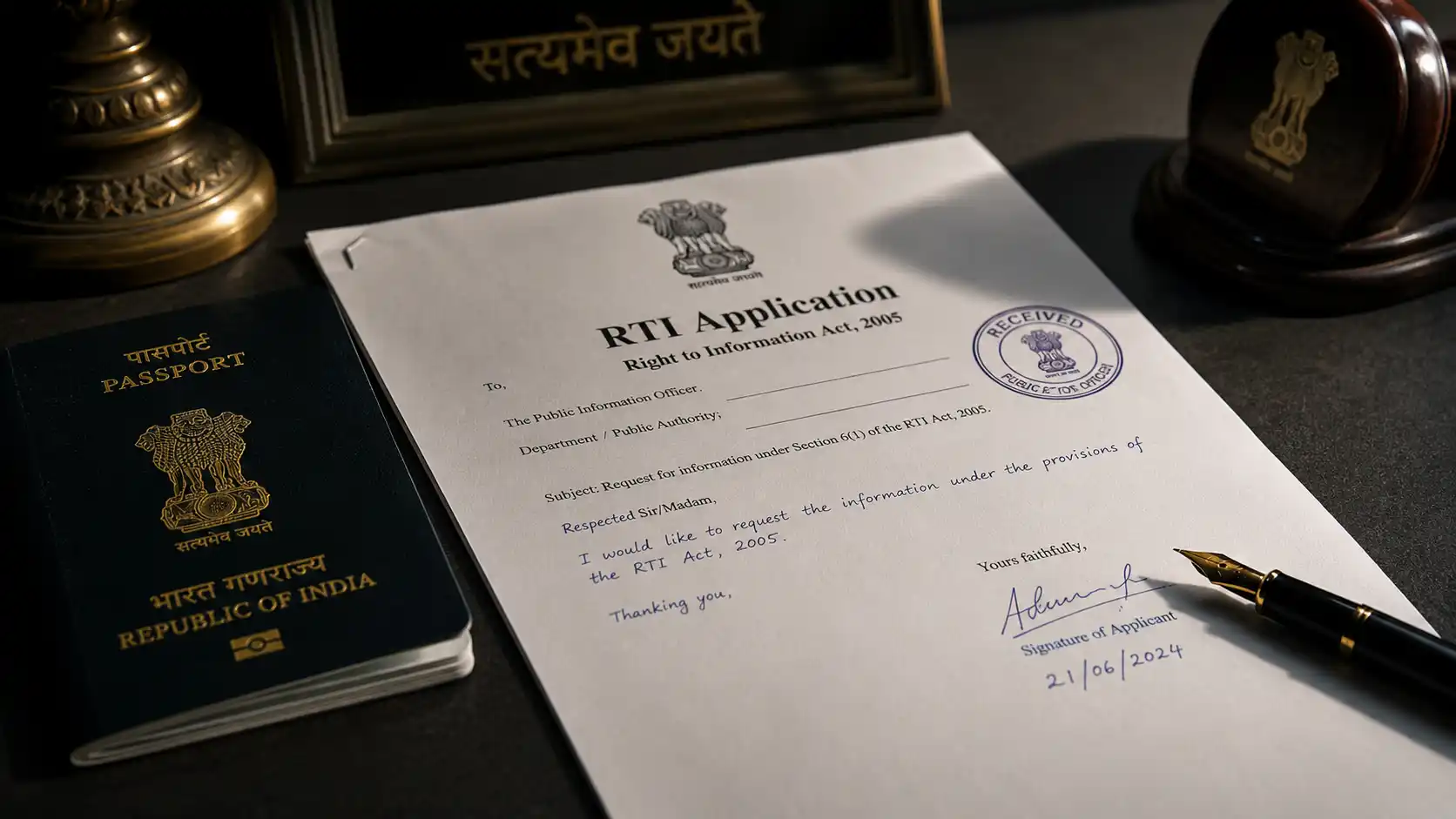
Here are two highly effective formats. You can type this out on a plain white A4 sheet or write it by hand using a blue/black pen.
Format 1: To Check Pending Application Status
Use this format if your work (like a Passport, Pension, Marksheet, or Certificate) is stuck in a government office for an unusually long time.
APPLICATION UNDER SECTION 6(1) OF THE RIGHT TO INFORMATION ACT, 2005
To, The Public Information Officer (PIO), [Name of the Department, e.g., Regional Passport Office] [Complete Address of the Department]
1. Full Name of the Applicant: [Your Full Name] 2. Address: [Your Complete Postal Address with PIN Code] 3. Contact Details: [Your Mobile Number and Email ID]
4. Details of Information Requested: Respected Sir/Madam,
I had submitted an application for [Mention the purpose, e.g., issuance of a fresh passport] at your office on [Date of submission]. My application/file reference number is [Insert Receipt/File Number].
Under the provisions of the RTI Act, 2005, please provide the following information regarding my application:
a) Please provide the daily progress report of my application from the date of submission till the date of your reply to this RTI. b) Please provide the names and designations of the officials with whom my application has been pending during this period. c) As per the citizen's charter or departmental rules, what is the maximum stipulated time limit to process and resolve such an application? d) If my application is currently pending or on hold, please provide a certified copy of the exact reasons recorded in the file for this delay.
5. Application Fee Details: I have attached a Postal Order / Demand Draft of Rs. 10/- bearing number [Insert IPO Number] dated [Insert Date] in favor of the Accounts Officer, [Department Name].
6. Declaration: I state that the information sought does not fall within the restrictions contained in Section 8 of the RTI Act and to the best of my knowledge, it pertains to your office. I am a citizen of India.
Place: [Your City] Date: [Insert Date]
Signature of Applicant: ___________________________
Format 2: To Seek Public Information (Civic Issues)
Use this format if you want to expose civic apathy—like finding out why a road in your locality was built poorly, or where the municipal funds were spent.
APPLICATION UNDER SECTION 6(1) OF THE RIGHT TO INFORMATION ACT, 2005
To, The Public Information Officer (PIO), [Name of the Municipal Corporation / PWD Department] [Complete Address]
1. Full Name of the Applicant: [Your Full Name] 2. Address: [Your Complete Postal Address]
4. Details of Information Requested: Respected Sir/Madam,
Under the provisions of the RTI Act, 2005, please provide certified copies of the following information pertaining to the construction and repair of the public road located at [Insert exact road name and landmark, e.g., Main Street, from Point A to Point B, Ward No. 12]:
a) Please provide a certified copy of the work order issued to the contractor for the construction/repair of the above-mentioned road during the financial year 2024-2025. b) Please provide the name, address, and contact details of the contractor who was awarded this tender. c) What was the total approved budget for this specific road project, and how much payment has been released to the contractor till date? d) Please provide a certified copy of the material quality test report and the completion certificate signed by the inspecting engineer for this project.
5. Application Fee Details: Attached is an Indian Postal Order (IPO) of Rs. 10/- bearing number [Insert IPO Number].
Place: [Your City] Date: [Insert Date]
Signature of Applicant: ___________________________
How to Submit Your RTI Offline (The 3 Steps)
While you can file RTIs online for Central Government departments via the official RTI portal, many State Government departments (like local police stations, municipalities, and state universities) still operate heavily on offline RTIs. Here is how to file it flawlessly:
Step 1: Get an Indian Postal Order (IPO) Go to your nearest post office and ask for an Indian Postal Order (IPO) of Rs. 10. This is the standard RTI application fee across most states in India (Below Poverty Line/BPL cardholders are exempt from this fee). Leave the "Pay to" section blank if you are unsure; you can fill it later as "Accounts Officer" of that specific department.
Step 2: Attach the Documents Take the printed RTI application and attach the original Rs. 10 Postal Order to it. If you are asking about a personal file, attach a photocopy of your original application receipt or ID proof. Do not send original documents.
Step 3: Send via Speed Post Only Put everything in an envelope. Address it to "The Public Information Officer (PIO)" of the department. Never send an RTI via ordinary post or courier. Always use India Post's Speed Post or Registered Post. Keep the postal tracking receipt safely. The 30-day countdown begins the day the tracking shows "Delivered."
What Happens Next?
By law, the PIO has exactly 30 days to reply to your application. If they fail to reply, or if they give you incomplete or misleading information, you have the absolute right to file a "First Appeal" to a senior officer within the same department.
The moment a government official sees an RTI application sitting on their desk—especially one asking for a "daily progress report"—they realize that this citizen knows their rights. Nine times out of ten, instead of calculating the delay, the officer will immediately clear your pending file to avoid answering tough questions on paper.
Stop waiting helplessly. Draft your RTI today, spend Rs. 10 at the post office, and hold the system accountable!