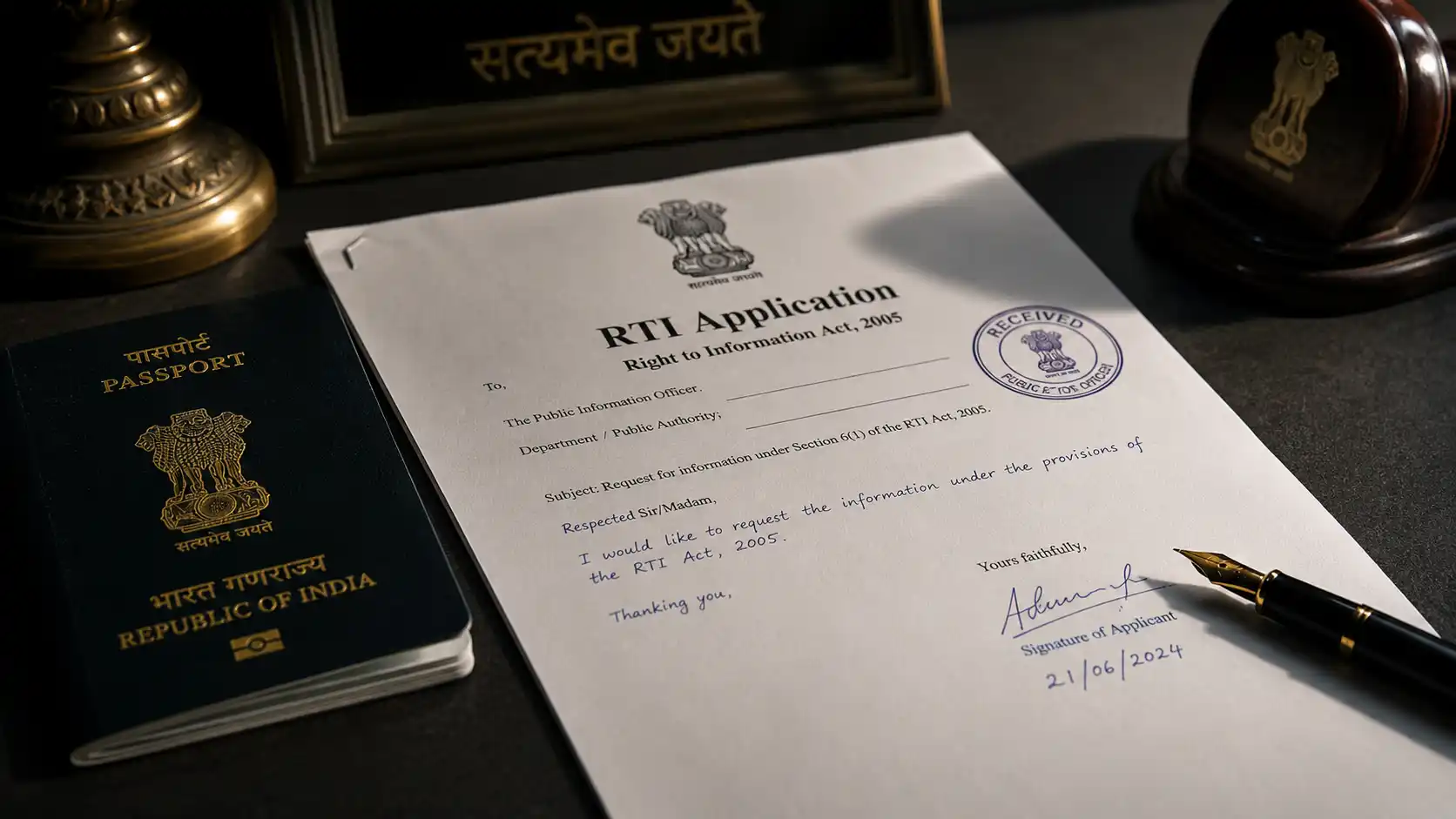
Few things in daily Indian life are as frustrating as administrative inertia. You apply for a fresh passport or renewal, complete your police verification, and then wait months for the dispatch status to update. Or perhaps your Provident Fund (PF) claim has been unfairly rejected without cause, your grandmother's pension has been abruptly stopped, your local road has remained broken for years despite allocated government funds, or your property registration document is stuck in bureaucratic red tape.
When visiting government offices in person leads to endless delays, evasive excuses, or subtle hints for illegal speed money, Indian citizens possess a powerful constitutional weapon: The Right to Information (RTI) Act, 2005.
Under the RTI Act, every Indian citizen has the statutory right to request information, inspect official government files, demand certified copies of public records, and seek daily progress reports regarding pending applications from any central, state, or local public authority.
The true magic of an RTI application lies in accountability. The moment a Public Information Officer (PIO) receives a formal RTI enquiry, they face a strict statutory clock: They must provide answers within 30 calendar days or face personal financial penalties of Rs. 250 per day (up to Rs. 25,000) deducted directly from their salary.
In this ultimate legal guide, we cover the core rules of the RTI Act 2005, provide two free ready-to-use RTI application formats (a general standard draft and a specialized template for delayed government work/passport), explain the First Appeal process, and walk you through filing an online RTI on rtionline.gov.in.
Core Principles of the Right to Information Act, 2005
Before drafting your RTI, understand these foundational rules that protect your rights as an applicant:
- No Explanation Required: Under Section 6(2) of the RTI Act, an applicant is NOT required to give any reason for seeking information or explain why they need the records.
- Mandatory 30-Day Response Timeline: The Public Information Officer must supply the requested information within 30 days of receiving the application.
- Life and Liberty Exception (48 Hours): If the information sought concerns the life or liberty of a person, the PIO must provide the information within 48 hours.
- Minimal Statutory Fee: The application fee for Central Government departments is just Rs. 10. Citizens living Below the Poverty Line (BPL) are completely exempt from paying any fees.
- Penalty on Officers: If a PIO refuses an application without reasonable cause, delays response beyond 30 days, or provides knowingly false/misleading information, the Information Commission can impose a penalty of Rs. 250 per day up to a maximum of Rs. 25,000 under Section 20(1).
How to Identify the Right Authority & Information Officer
To get a fast response, your application must be addressed to the correct Public Information Officer (PIO) / Central Public Information Officer (CPIO):
[Determine Government Department] ➔ [Identify CPIO / SPIO Designation] ➔ [Submit via Post or Online Portal]
- Central Government Offices (Passport, EPFO, Income Tax, Railways, Postal): Addressed to the Central Public Information Officer (CPIO) of the respective ministry or department.
- State Government Offices (Police, RTO, Land Records, Municipalities, Ration): Addressed to the State Public Information Officer (SPIO) of the concerned state department.
- Banks & PSUs (SBI, PNB, LIC, IOCL): Every public sector bank branch or regional office has a designated CPIO/PIO responsible for customer RTI queries.
Template 1: General Offline RTI Application Format (Standard Form A)
Use this universal RTI template to request information, inspect files, or obtain certified copies of records from any Central or State Public Authority.
RTI APPLICATION FORM (Under Section 6(1) of the Right to Information Act, 2005)
Date: [Insert Date]
TO: The Central Public Information Officer (CPIO) / State Public Information Officer (SPIO), [Name of the Department / Public Authority, e.g., Regional Passport Office / EPFO / Municipal Corporation] [Office Address] [City, State, PIN Code]
1. FULL NAME OF APPLICANT: [Your Full Legal Name] 2. FATHER'S / HUSBAND'S NAME: [Insert Name] 3. POSTAL ADDRESS FOR CORRESPONDENCE: [Your Complete Residential Address with PIN Code] 4. CONTACT DETAILS: Mobile: [+91-XXXXXXXXXX] | Email: [Your Email Address]
5. PARTICULARS OF INFORMATION REQUIRED: (Please provide specific, clear, and point-wise information regarding [topic, e.g., File/Application No. XYZ]):
- Point 1: Please provide the daily progress report/movement history of my application/file bearing Reference/File No. [Insert File/Application Number] submitted on [Date of Submission].
- Point 2: Please provide the names, designations, and office contact details of all officials/officers with whom my file remained pending from [Submission Date] till date, along with the specific period it was held by each official.
- Point 3: As per your department’s Citizen Charter / rules, what is the prescribed statutory time frame within which such applications are required to be processed and disposed of?
- Point 4: Please provide certified copies of all official notes, file notations, internal correspondence, and remarks recorded on my file by the processing officers.
- Point 5: If my application/file has not been processed within the prescribed time limit, please state the specific administrative reasons recorded for the delay.
6. PERIOD TO WHICH INFORMATION PERTAINS: From [Start Date] to [Present Date].
7. APPLICATION FEE DETAILS: I have enclosed the mandatory application fee of Rs. 10/- vide:
- [ ] Postal Order / Demand Draft No: [Insert 6-Digit IPO Number] dated [Date] drawn in favor of "[Name of Accounts Officer, e.g., Accounts Officer, RPO Delhi]".
- [ ] Court Fee Stamp / Cash Receipt No: [Insert Receipt Details].
- [ ] I belong to the BPL Category (Copy of valid BPL Certificate attached herewith for fee exemption).
8. FORMAT OF INFORMATION REQUIRED: I request you to send the certified copies of the information to my correspondence address mentioned above via Registered / Speed Post.
DECLARATION: I state that I am a citizen of India and the information sought falls within the domain of public interest and the RTI Act, 2005.
Place: [Your City] Date: [Insert Date]
SIGNATURE OF APPLICANT (Signature) [Your Full Legal Name]
Template 2: Specialized RTI Draft for Delayed Passport / Police Verification
If your passport issuance or renewal is delayed despite completing police verification, send this targeted RTI query directly to the Regional Passport Office (RPO).
RTI APPLICATION REGARDING DELAYED PASSPORT ISSUANCE (Under Right to Information Act, 2005)
TO: The Central Public Information Officer (CPIO), Regional Passport Office, [Name of RPO City, e.g., Regional Passport Office, Kolkata] [RPO Office Address & PIN Code]
1. APPLICANT DETAILS:
- Name: [Your Full Name]
- Address: [Your Address]
- Mobile: [+91-XXXXXXXXXX] | Email: [Your Email]
2. INFORMATION SOUGHT: Regarding my Passport Application bearing File No: [Insert Passport File Number, e.g., CA1071234567826] submitted at Passport Seva Kendra (PSK) [PSK Location] on [Date of Application]:
- Query 1: Please state the current status and exact stage of processing of my Passport File No. [File Number].
- Query 2: Please provide a certified copy of the Police Verification Report (PVR) received by your office from the District Police / Special Branch regarding my application, along with the date of receipt of the PVR.
- Query 3: If the Police Verification Report is marked clear, please state the reason why my passport has not been printed and dispatched within the prescribed standard turnaround time of 30 days.
- Query 4: Please provide the daily progress sheet showing the movement of my passport file between various desks in the Regional Passport Office from [Date] to till date.
- Query 5: Please state the tentative date by which my passport will be printed and dispatched to my address.
3. FEE PAYMENT: An Indian Postal Order (IPO) No. [IPO Number] of Rs. 10/- dated [Date] payable to "Accounts Officer, Regional Passport Office, [City]" is enclosed herewith.
Place: [Your City] Date: [Insert Date]
SIGNATURE OF APPLICANT (Signature)
How to File an RTI Application Online (rtionline.gov.in)
For Central Government ministries, departments, passport offices, and public sector banks, filing online via the official portal is fast, transparent, and eliminates postal delays:
[Visit rtionline.gov.in] ➔ [Click 'Submit Request'] ➔ [Select Ministry / Department] ➔ [Type Query (3000 chars)] ➔ [Pay Rs. 10 Online]
- Access Portal: Go to
https://rtionline.gov.in(official Portal of Government of India). - Submit Request: Read guidelines, check the "I have read" box, and click "Submit".
- Select Ministry/Department:
- For Passport queries: Select Ministry ➔ Ministry of External Affairs ➔ Select Authority ➔ Regional Passport Office, [Your City].
- For PF/EPFO queries: Select Ministry ➔ Ministry of Labour and Employment ➔ Select Authority ➔ Employees Provident Fund Organisation (EPFO).
- For Banking queries: Select Ministry ➔ Department of Financial Services ➔ Select your specific Public Sector Bank.
- Enter Personal Details: Fill in your name, complete postal address, pin code, and email ID.
- Draft RTI Text: Type your point-wise RTI queries in the text box (up to 3000 characters). You can also upload a supporting PDF document (up to 1 MB).
- Payment & Receipt: Pay the Rs. 10 fee using UPI, Net Banking, or Debit/Credit Card. Save and print the RTI Registration Number generated for tracking.
What to Do If RTI is Rejected or Ignored: Filing First Appeal (Section 19(1))
If the Public Information Officer fails to respond within 30 days, or provides incomplete/evasive answers, do not lose hope. You have the statutory right to file a First Appeal under Section 19(1) of the RTI Act.
Rules for First Appeal:
- Time Limit to File Appeal: Within 30 days from the expiry of the response period (or 30 days from receiving the unsatisfactory reply).
- Filing Authority: Address the appeal to the First Appellate Authority (FAA)—an officer senior in rank to the CPIO/PIO in the same department.
- Appeal Fee: There is NO fee for filing a First Appeal for Central Government departments.
FIRST APPEAL FORMAT UNDER SECTION 19(1) OF RTI ACT
TO: The First Appellate Authority (FAA), [Name of Department, e.g., Regional Passport Office / EPFO] [Office Address]
1. Name & Address of Appellant: [Your Name & Complete Address] 2. Details of CPIO: [Name & Designation of CPIO who failed to reply / gave unsatisfactory reply] 3. Original RTI Registration / IPO No: [Insert Registration Number & Date] 4. Date of Submission of Original RTI: [DD/MM/YYYY] 5. Reason for Appeal:
- [ ] No response received within mandatory 30-day period u/s 7(1).
- [ ] Misleading / incomplete / evasive reply provided by CPIO on Date [Insert Date].
6. PRAYER / RELIEF SOUGHT: The Appellant prays that the Hon'ble First Appellate Authority may be pleased to direct the CPIO to immediately provide complete, certified, point-wise information free of cost as mandated under Section 7(6) of the RTI Act, and initiate disciplinary proceedings against the CPIO under Section 20.
Date: [Insert Date] | Signature of Appellant: __________________
What Information CANNOT Be Sought? (Section 8 Exemptions)
While the RTI Act is broad, Section 8 lists specific information that public authorities are legally permitted to withhold:
| Exemption Category | What Is Protected | Reason for Exemption |
|---|---|---|
| National Security (Sec 8(1)(a)) | Military operations, defense strategies, intelligence reports. | Threat to sovereignty and integrity of India. |
| Cabinet Papers (Sec 8(1)(i)) | Internal discussions of Council of Ministers and Cabinet. | Exempt until decision is finalized and implemented. |
| Personal Privacy (Sec 8(1)(j)) | Third-party personal details (income tax returns, medical records, marks of other candidates). | Invasion of personal privacy without public interest. |
| Exempted Agencies (Sec 24) | Intelligence & Security organizations (IB, RAW, CBI, ED). | Exempted except for allegations of corruption and human rights violations. |
5 Critical Mistakes to Avoid When Drafting an RTI Query
- Asking "Why" Questions / Seeking Opinions: RTI is for requesting existing records, documents, or data. Do not ask "Why did the officer reject my file?" Instead ask: "Please provide certified copies of file notations and written reasons recorded for rejecting my application."
- Writing Long, Emotional Letters: Keep your RTI queries concise, professional, and strictly formatted as numbered points. Avoid writing lengthy background complaints.
- Addressing the Wrong Accounts Officer on Postal Orders: When sending offline RTI via Indian Postal Order (IPO), ensure the "Pay To" field is drawn correctly (e.g., "Accounts Officer, [Department Name]"). Incorrectly drawn IPOs are returned rejected.
- Forgetting to Attach Proof of Delivery: When sending physical RTI applications, always use Speed Post and staple the India Post receipt to your office copy for tracking.
- Not Citing Section 7(6) for Delayed Replies: If a CPIO provides information after the 30-day limit has expired, they cannot charge copying fees (e.g., Rs. 2 per page). Information provided after delay must be provided completely free of cost.
Conclusion
The Right to Information Act, 2005 is one of the most effective tools for enforcing transparency and administrative responsiveness in India. By utilizing the structured RTI application formats, online portal steps, and First Appeal procedures outlined in this guide, you can break through bureaucratic bottlenecks and claim the official information and services you are legally entitled to.
*Disclaimer: This blog post and downloadable RTI formats are provided strictly for educationa