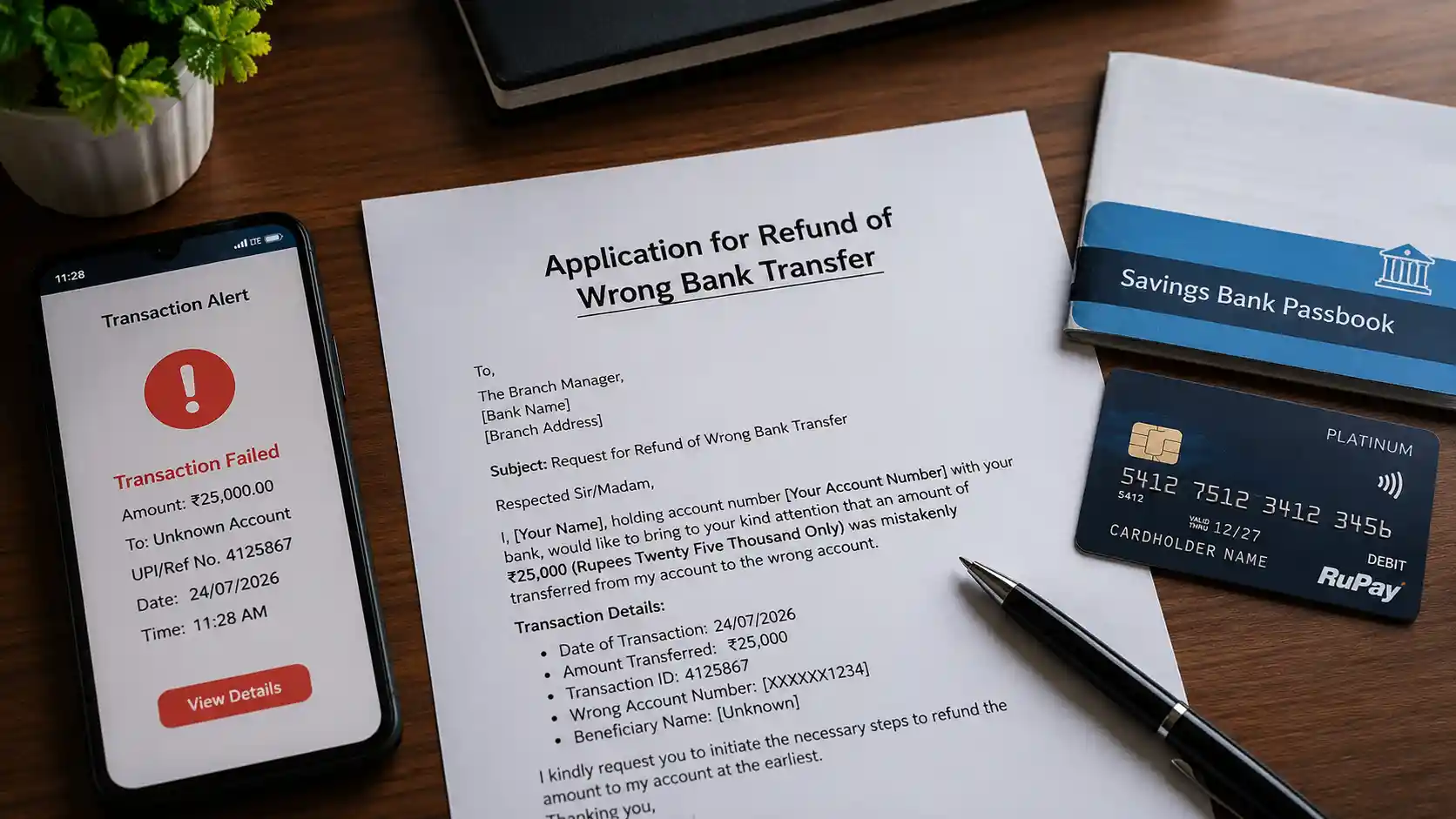
It happens in a split second: You open Google Pay, PhonePe, Paytm, or your bank's net banking app to send money to a friend, vendor, or family member. You type in the mobile number, UPI ID, or 16-digit account number... miskey a single digit, hit "Pay", enter your UPI PIN, and tap submit.
A second later, your heart drops. The screen displays "Payment Successful", but the recipient name that flashes on the confirmation screen is someone completely unknown to you. You have accidentally transferred your hard-earned money into a wrong bank account.
With India's digital payment ecosystem handling billions of UPI, IMPS, and NEFT transactions every month, wrong money transfers have become one of the most common banking emergencies.
The immediate question that grips anyone in this situation is: Can I get my money back? Is the bank responsible for reversing the transaction?
The short answer is YES, you can recover your money, provided you act quickly and follow the correct legal and banking protocol laid down by the Reserve Bank of India (RBI) and National Payments Corporation of India (NPCI).
In this comprehensive guide, we explain RBI guidelines on wrong online fund transfers, detail the immediate 3-step action plan, provide two free ready-to-use application formats (for your Home Bank and the Beneficiary's Bank), and outline legal remedies if the wrong recipient refuses to return your funds.
RBI Guidelines on Wrong Bank Transfers: Who is Responsible?
Before taking action, it is essential to understand the legal mechanics of an online money transfer in India:
1. The "Account Number Rules" Directive
As per RBI directives, during online electronic fund transfers (NEFT, RTGS, IMPS, and UPI), the primary responsibility for entering the correct account number and IFSC code rests solely with the remitter (the sender). Banks are automated system processors; their servers clear transactions based on the account number entered, without manually cross-checking if the account holder's name matches the number.
2. The Bank's Duty as a Facilitator
While the bank is not automatically liable for your typing mistake, RBI mandates that both the Remitter Bank (your bank) and the Beneficiary Bank (recipient's bank) must actively cooperate and facilitate the recovery process. Once notified, the beneficiary bank is obligated to contact the wrong recipient and seek their written consent to debit the money back to your account.
3. Unjust Enrichment Under Indian Law
Legally, keeping money credited into one's account by mistake is classified as "Unjust Enrichment" under Section 72 of the Indian Contract Act, 1872. A person who receives money by mistake is under strict legal obligation to return it to the rightful owner.
Immediate Action Plan: 3 Steps to Take Within 2 Hours
Speed is your greatest ally when recovering funds sent to a wrong account. Execute these three steps immediately: [1. Save UTR Number & Take Screenshots] ➔ [2. Raise Dispute on App / NPCI Portal] ➔ [3. Submit Written Application to Bank]
Step 1: Save the Transaction Reference (UTR Number)
Locate the 12-digit Unique Transaction Reference (UTR) or RRN Number from your payment app or bank SMS notification. Take clear screenshots of the transaction receipt showing the date, time, wrong account/UPI ID, and amount debited.
Step 2: Raise an In-App Dispute & Report on NPCI Portal
- For UPI Transfers (GPay, PhonePe, Paytm, BHIM): Open the specific transaction inside the app ➔ Click "Raise Concern" or "Report Fraud/Issue" ➔ Select "Transferred to wrong account / incorrect recipient".
- Report on NPCI Portal: Visit
npci.org.in➔ Go to "Get in Touch" ➔ Click "UPI Complaint" ➔ Under Transaction section, select "Incorrectly transferred to another account" ➔ Fill in your UTR number and details.
Step 3: Inform Your Home Bank Branch Manager
Contact your home bank branch immediately. If the wrong transfer occurred during non-banking hours, call their 24/7 toll-free helpline number to register a formal ticket and request them to flag the transaction to the beneficiary bank.
Application Format 1: Written Application to Your Home Bank Manager (Remitter Bank)
Use this formal written application when submitting your complaint to your own bank branch where your account is held. Submit two copies to get an official stamped acknowledgement.
To, The Branch Manager, [Name of Your Bank, e.g., State Bank of India] [Branch Name & Full Address] [City, State, PIN Code]
Date: [Insert Date of Application]
SUBJECT: Application for urgent recovery of money accidentally transferred to wrong bank account vide UTR No. [Insert UTR Number]
Respected Sir/Madam,
I maintain a Savings Account bearing Number [Your Account Number] with your branch under IFSC Code [Your Branch IFSC].
I am writing to urgently report an erroneous money transfer that occurred from my account on [Date of Transaction] at [Time, e.g., 03:15 PM].
Due to a typographical error while entering the recipient's details, an amount of Rs. [Amount in Figures]/- (Rupees [Amount in Words] Only) was mistakenly transferred to an unintended recipient account instead of the intended beneficiary.
Details of the Erroneous Transaction:
- Date & Time of Transfer: [DD/MM/YYYY at HH:MM AM/PM]
- Mode of Transfer: [UPI / IMPS / NEFT / Net Banking]
- Transaction Reference / UTR Number: [Insert 12-digit UTR Number]
- Amount Transferred: Rs. [Amount]/-
- Wrong Recipient Account No / UPI ID: [Insert Wrong Account Number or UPI ID]
- Wrong Recipient Bank Name: [e.g., ICICI Bank / HDFC Bank]
- Intended Beneficiary Account No: [Insert Intended Recipient Account Number]
As per RBI guidelines on wrong fund transfers, I request you to kindly initiate an official recovery process with the Beneficiary Bank ([Name of Recipient Bank]) via the National Payments Corporation of India (NPCI) / Interbank reconciliation protocol.
I request you to mark a hold/lien on the specified amount in the wrong recipient's account and arrange for the safe re-credit of Rs. [Amount]/- back to my savings account at the earliest.
I have attached a photocopy of the transaction confirmation slip, bank passbook/statement highlighting the debit, and my ID proof for your verification.
Thanking you for your prompt cooperation.
Yours faithfully,
(Signature) [Your Full Legal Name] [Your Account Number] [Your Registered Mobile Number] [Your Email Address]
Enclosures:
- Copy of Payment Confirmation Screenshot / Transaction Slip with UTR.
- Copy of Bank Passbook / Account Statement showing the debited entry.
- Copy of Aadhaar Card / PAN Card.
Application Format 2: Written Application to the Beneficiary Bank Manager (Recipient Bank)
If the wrong recipient holds an account in a different bank (e.g., you sent money from SBI to a wrong ICICI Bank account), visiting or emailing the Beneficiary Bank Branch Manager directly accelerates the fund freezing process significantly.
To, The Branch Manager, [Name of Beneficiary Bank, e.g., ICICI Bank] [Branch Name / Head Office Address] [City, State, PIN Code]
Date: [Insert Date]
SUBJECT: Intimation of wrong credit of Rs. [Amount] into Account No. [Wrong Recipient Account No] - Request for fund reversal
Respected Sir/Madam,
I am writing to bring to your attention an accidental money transfer made into a savings/current account maintained with your bank branch.
On [Date] at [Time], I attempted an online fund transfer via [UPI/IMPS/NEFT] from my [Your Bank Name] Account No. [Your Account No]. Due to an inadvertent typing error, the funds were wrongfully routed to an account in your branch belonging to [Name of Wrong Recipient, if known] bearing Account Number [Wrong Recipient Account Number].
Key Transaction Particulars:
- Remitter Name & Bank: [Your Name], [Your Bank Name]
- Beneficiary Account No in Your Bank: [Wrong Recipient Account Number]
- 12-Digit UTR / Transaction Ref No: [Insert UTR Number]
- Exact Amount Credited: Rs. [Amount in Figures]/-
In light of Section 72 of the Indian Contract Act, 1872 (obligation of person who receives money under mistake) and relevant RBI directives, I request you to:
- Inform the account holder regarding this erroneous credit.
- Obtain written consent from the account holder to reverse the funds.
- Temporarily hold/freeze the credited amount of Rs. [Amount]/- to prevent unauthorized withdrawal or spending.
- Remit the funds back to my originating bank account.
My home bank ([Your Bank Name]) has already logged a formal interbank dispute under Reference Ticket No. [Insert Ticket No if available].
I appreciate your timely assistance in protecting consumer funds.
Yours sincerely,
(Signature) [Your Full Legal Name] [Your Contact Mobile Number] [Your Address]
What Happens When Money is Sent to a Wrong Account? (2 Scenarios)
The recovery workflow differs based on whether the wrong account details exist or are invalid:
[Wrong Fund Transfer Initiated] │ ┌──────────────────────────┴──────────────────────────┐ ▼ ▼ [Scenario A: Invalid Account / IFSC] [Scenario B: Valid Account Exists] │ │ ▼ ▼ [Transaction Fails Automatically] [Money Credited to Recipient] │ │ ▼ ▼ [Auto-Refunded in 1 to 3 Days] [Requires Bank & Recipient Consent]
Scenario A: The Wrong Account Number or IFSC Code Does Not Exist
If you mistyped an account number that does not match any active bank account, or entered an invalid IFSC code, the transaction will fail automatically. The money will be routed back and credited to your original bank account within 24 to 72 hours (T+1 or T+3 business days) without requiring any application.
Scenario B: The Wrong Account Number Belongs to a Real Person
If the mistyped account number belongs to a valid, active account holder, the money will be credited instantly. In this case, neither your bank nor the recipient's bank can forcefully deduct money from their account without the recipient's written permission/consent. The bank must contact the recipient, explain the mistake, and request approval to reverse the transfer.
What to Do If the Wrong Recipient Refuses to Return Your Money?
In rare cases, the person who received the wrong credit may act dishonestly, refuse to give consent, or spend the money. If this happens, follow these legal remedies:
1. File a Police Complaint for Criminal Breach of Trust
Refusing to return money received by mistake constitutes an offence under the Indian Penal Code / Bharatiya Nyaya Sanhita (BNS):
- Section 316 of BNS (formerly IPC Section 403): Dishonest misappropriation of property.
- Section 318 of BNS (formerly IPC Section 420): Cheating and dishonestly inducing delivery of property.
Visit your local police station or Cyber Crime Cell with your bank transaction statement, the bank's correspondence letter showing the recipient's refusal, and submit a written complaint. Once police contact the recipient, most individuals return the money immediately to avoid legal prosecution.
2. File a Summary Civil Suit for Recovery
You can file a Summary Suit under Order 37 of the Code of Civil Procedure (CPC) in a local Civil Court for the recovery of money paid under mistake (unjust enrichment). Courts generally rule in favor of the sender, ordering the recipient to return the money along with court costs and interest.
Key Evidence Checklist for Wrong Transfer Complaints
When visiting your bank or drafting your application, ensure you have these documents organized:
| Document Type | Details Required | Purpose |
|---|---|---|
| Transaction Receipt | Screenshot from GPay/PhonePe or Net Banking PDF showing 12-digit UTR. | Proves transfer completion and exact timestamp. |
| Bank Statement | Passbook copy or PDF statement highlighting the debited entry. | Establishes physical loss of funds from your account. |
| NPCI Complaint Ticket | Acknowledgment PDF or SMS from npci.org.in. |
Shows you initiated official portal escalation. |
| Government ID | Self-attested copy of Aadhaar Card or PAN Card. | Validates your identity as the legitimate account owner. |
4 Golden Rules to Prevent Wrong Money Transfers
- Send Re. 1 First for Large Transfers: When making large transactions (e.g., Rs. 10,000 or more) to a new beneficiary, always send Re. 1 first. Confirm with the recipient that they received it before transferring the remaining balance.
- Double-Check Recipient Name on UPI: UPI payment apps automatically fetch and display the official bank registered name of the beneficiary before you enter your PIN. Always verify that the displayed name matches your intended recipient.
- Avoid Copy-Pasting Numbers with Spaces: Manually verify account numbers digit by digit instead of blind copy-pasting from chat messages where hidden spaces can alter numbers.
- Use QR Codes Where Possible: Scanning a vendor's official QR code eliminates typing errors entirely.
Conclusion
Mistakenly transferring money to a wrong account is stressful, but it is a recoverable situation. By acting within the golden hours, filing formal in-app and NPCI disputes, and submitting the written bank application formats provided above, you enforce your consumer rights and ensure a smooth reversal of your hard-earned funds.
*Disclaimer: This blog post and downloadable application templates are provided strictly fo